Showing posts with label beer. Show all posts

Thursday, December 04, 2014

"7-11 exclusive" beer - Grand Kirin - Japan 10/2014

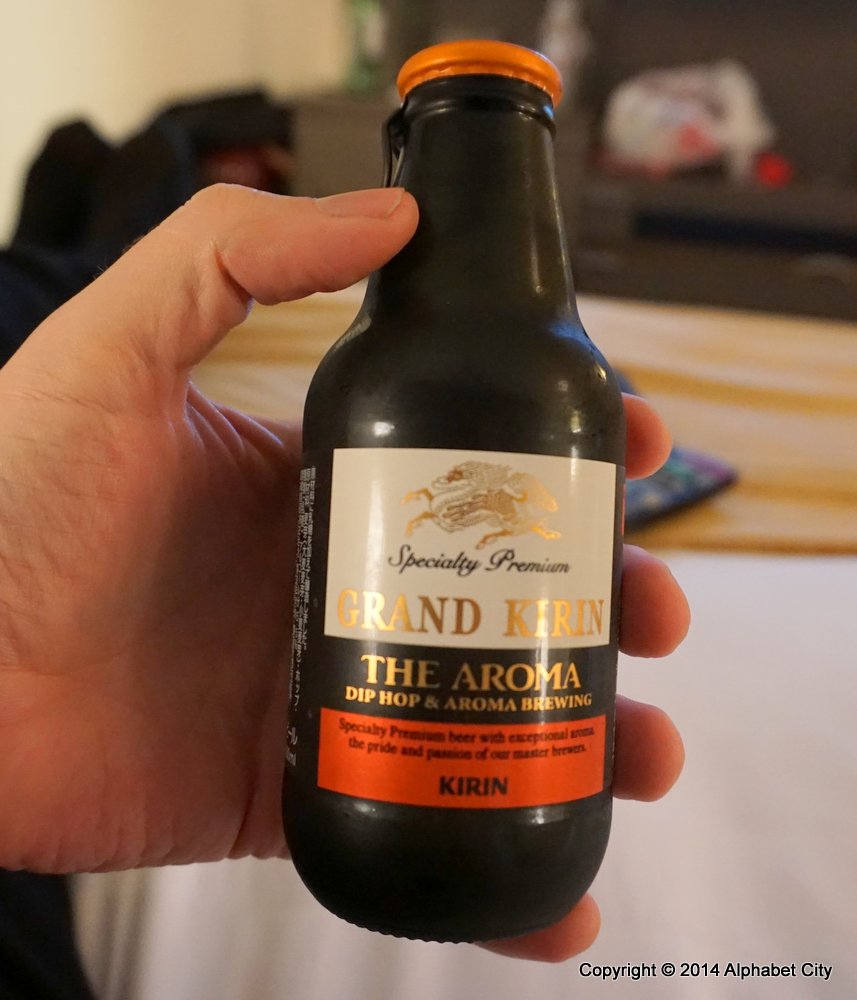
I feel like I didn't actually do that much new and interesting on this trip to Japan, but I did take a bunch of photos of random weird stuff. One of those is Grand Kirin, a high-end beer that you can only get at Japanese 7-11's:


I'm not sure what "dip hop & aroma brewing" means. It comes in a funky bottle with a funky cap that's halfway between a regular beer bottle cap and a 1980's-vintage pull tab:


It tasted pretty good, although basically like a double strong version of Kirin. It was very malty. That's one thing I've noticed about the Japanese and beer - they love the flavor of malt. Every beer that tries to be premium advertises how malty it is. It's what they think good beer is supposed to be. And this one really is.

I will say that there's something about Japan that always temporarily turns me into a heavy beer drinker. Generally, their beers are just a lot more drinkable than ours - including our alleged imports from Japan! They're very clean and fresh tasting but they still have a lot more flavor (of malt, mostly) than our beers. And people drink them at all hours, everywhere - it's not necessarily weird to get on the train at 9AM and crack open a beer. (Though it does somewhat depend on the kind of train.)

Anyway, more random stuff soon!

Sunday, June 22, 2008

Japanese beer found!

I've written before about how frustrated I am with the utter lack of real Japanese beer in this country these days. It's a goddamn travesty, especially as sophisticated as Americans are getting lately when it comes to beer, with imports and craft beers accounting for almost all of the industry's growth. Nobody wants to drink what amounts to a Molson or Budweiser when they order a Japanese beer. Even at both trendy high-end places and rustic, authentic ramen shops, if you ask for a Kirin or Sapporo, you're gonna get something from Canada or California, not Japan. And no, it doesn't taste the same.

But wait! Behold:

What's this?!

Not only is that real Japanese beer, it's a brand that doesn't even exist in the United States. Impress your friends with your Japanophile status by drinking Yebisu! I never thought I'd see this stuff here, in any form, much less the real stuff.

Yebisu is Sapporo's "premium" beer in Japan. I think it's basically malt liquor - it's advertised as an "all malt" beer. (They don't actually have a product called "malt liquor" there that I've seen). But it doesn't taste like the malt liquor I've had here, so maybe it's not the same - it's lighter, and it tastes basically like beer. You can definitely taste the malt, though; it's like a maltier version of, say, Heineken. It's not bad, but it's not my favorite beer. It's just so rare to find real Japanese beer in the US anymore that I had to post it.

I found it at Shin Nippon-do in Roslyn. Their web site, such as it is, is here.

btw, if you haven't read my earlier posts on the subject, you may wonder why a Sapporo beer is being brewed in Tokyo. Well, Sapporo itself is brewed all over Japan these days, not just Sapporo. But Yebisu has always been brewed in Tokyo. The neighborhood of Ebisu is named after it! (The beer's name is pronounced "Ebisu" - the "Y" is silent.) See, in the days when Yebisu was first created, there was a big problem keeping beer cold as it was transported, and Sapporo beer from Sapporo just couldn't make the trip down south to Tokyo. So they created Yebisu for sale in the Tokyo region, using ingredients more commonly found there.

The one problem with this particular bottle of Yebisu? Yeah:

Talk about transport problems - $3.29 for a bottle of beer. Worth it? Nah. They're obviously tapping into the ex-pat homesickness factor. And yeah, it's nice to have a real taste of Japan, which is a rarity in the US these days. But I'd probably rather just drink a Brooklyn Lager ($6.99 for a six-pack) as my daily beer.

If I actually lived in Japan, though? Who knows!

Saturday, February 16, 2008

Brooklyn Local 1

I've talked about the Brooklyn Brewery before; they've pretty quickly become my favorite beer label in the United States. One thing I always thought was a little annoying about them, though, was their name. It's kind of a lie. All of their mass production is done in Utica. When they print "brewed in New York" on their bottles, they're technically correct, but I'm sure "New York" to most people means the city, not the state. Especially when "Brooklyn" is the name on the bottle.

I don't really blame them, though; their Brooklyn brewery (yeah, there is one) just doesn't have much capacity. They produce limited editions and draft beers there and that's about it.

Well, here's a real Brooklyn-brewed Brooklyn beer. It's fairly new, and it's not a limited edition. (At least not that I know of.) One of my wife's friends gave it to us as a little gift; I don't know where we can actually buy it around here. Well, outside the brewery, that is.

This is Brooklyn Local 1.

Not for nothing, it comes in a Champagne bottle.

This is basically a Belgian style "strong pale ale", though it doesn't taste quite like any I've ever had before and the brewery claims it's really got its own style. It pours deceptively light, cloudy like a Belgian beer should be, and with a pure white head. Its aroma is pretty immediate; very floral. Looking at it, I imagined something sweet and crisp and watery.

I love a beer that makes me go "hooooooooo!" after my first taste. I wasn't expecting to get hit so hard. It's not overpowering or heavy like an Imperial Stout - don't get me wrong - but it's pretty much a taste explosion. It's got an everything-but-the-kitchen-sink kinda thing going on, but not in a bad way. Nothing really seems out of place. There's tons of citrus, florals, coriander and hops going on. It's very peppery. They've somehow managed to make it both bitter and sweet at the same time - I've really never experienced that in a beer before. And yes, being a strong beer, you can taste a little of the alcohol - though it's not unpleasant in context, like a good wine.

(By the way, you see up there that I finally bought some proper beer glasses. There are different types of beer glass, but I like steins the best because their design and heavy construction keeps the beer at a decent temperature all the way to the end. There's nothing worse than taking that last sip of warm, skunky beer from the bottom of a pilsner glass.)

One thing that's amazing about this beer is that it's naturally carbonated. It's old-school. Supposedly, they don't even make beer this way in Belgium itself anymore. I've seen reports that "very little" CO2 is added - I'm not sure what that means, but the majority of the carbonation comes from warm room fermentation. That might explain some of the complexity and seemingly impossible flavor combinations that you just don't find in other beers.

You will get drunk from a 750ml bottle of this beer, no doubt. That's a pretty big bottle, and it's 9% alcohol. And you will enjoy every sip getting there.

Look for this stuff. It's worth it.

Thursday, January 17, 2008

The Budweiser Alternative - Brooklyn Pilsner

I'm getting a little sick and tired of those Budweiser "Great American Lager" ads - you know, the ones where that smug idiot stands there and tries to convince everybody (and likely himself) that Budweiser is superior to "darker, cloudier beers" because lighter beers like Budweiser don't "mask flaws" like those other beers do.

What a bunch of bullshit.

For one thing, there's really no such thing as an "American-style Lager", as Budweiser refers to it in the ads. At least not as an actual beer category. Go ahead, Google it. What you'll find is a Wikipedia page that was first written in December of 2006 (and initially edited largely by one person), a couple of articles referring to said Wikipedia page, a few older posts and articles derisively referring to "American-style lager" not in any formal way but as a colloquialism, and then Budweiser's own site. You see the pattern here? Budweiser invented this term to explain away why their beer tastes like water. There are no real distinguishing characteristics to "American lager" other than a lack of taste. And that just arose from the two or three early major brewing companies cutting corners and using cheap ingredients like corn and rice in their beers, instead of proper hops and barley.

A little beer lesson for those coming here through Google. There are really only two kinds of beer: ale and lager. Everything else is a style of one of those two beer types. Even stouts, which are ales. Pilsners are lagers. What distinguishes an ale from a lager is the process used to make each. But effectively speaking, ales are sweet, lagers are dry and bitter.

If you want a "light" American beer (not a "lite" American beer) - and really, there is nothing wrong with that - you should drink this:

Yep, that's Brooklyn Pilsner. Budweiser is also just a (really bad) Pilsner, whatever they want to say about being "American-style Lager" - they always just called themselves a Pilsner before. Pilsner is already a light lager. The difference is Brooklyn Pilsner actually has taste.

I've been a fan of the Brooklyn Brewery for a while now, and not just because they're from Brooklyn. (Most of their beer, including the Pilsner, is actually brewed upstate in Utica.) I know I went on and on a while back about Japanese beers, all of which are also light lagers, but Brooklyn Pilsner is probably even better. It also has the advantage of being pretty widely available. Yeah, you might need to go to your local "beverage" store, but it's not at all hard to find. And this is really a top quality beer, not just "for an American beer", but I'd hold this up to any Pilsner you could dig up from anywhere around the world. (Remember, don't believe all you read on beer rating sites. Their results are skewed by a few people who believe that good beer has to look and taste like used motor oil. They never rate any pilsners very highly.)

Brooklyn Pilsner tastes extremely clean, like a Pilsner should, and is quite dry. The overall taste is pretty malty. The finish is very bitter, which may be an acquired taste, but this is the way lager is supposed to be. What the bitter finish does, though, is just make you want to drink more. By the end of a bottle, you feel as if your palette has actually been cleansed by the beer. That's pretty much exactly what Budweiser wants you to think about their beer in their new ads, but Brooklyn Pilsner's got about five times more taste and none of the skunk. I don't even think it's possible to skunk a Brooklyn Pilsner; I've never had one that was.

The great thing about Pilsners is that they go with pretty much any kind of food. That's probably why they're so popular around the world, and it's why Brooklyn Pilsner's become sort of my default beer now. (I was drinking Brooklyn Lager, and I still like it a lot, but it's a little too heavy for some foods.) Now look at this - this is what I call a winter meal:

Mmmm, chili under all that cheese, corn bread and an ice cold Brooklyn Pilsner. It don't get no better!

Sunday, November 11, 2007

Beer Review: Brooklyn Black Chocolate Stout

Something new today, and maybe a regular thing - heck, maybe the genesis of an all-new blog eventually. I'm writing a beer review.

There are plenty of people reviewing beer out there already. Why the hell should you listen to me? You're going to have to judge that for yourself. I will say I think my perspective's probably a little different than most - I'm not the same kind of beer snob that some beer snobs are. I love a good beer, but what is "good beer"? There are definitely things that are pretty easy to objectively measure and still other things that I think we can probably all agree on, but beyond that lies both the nebulous realm of personal taste and the purpose for which you drink beer in the first place. There's nothing wrong with a good lager while watching a football game.

Which brings us to Brooklyn Black Chocolate Stout. I picked this up looking for something a little different than the pale lagers I usually keep around. I looked forward to a deep, dark beer, having read well of it at ratebeer.com, the Zagat guide of the beer world. There, it rated 4.04 out of 5, which puts it in the 99th percentile of all beers in the world. (Few beers ever break 4 overall stars, both because there are always reviewers who dislike even the best beers, and because within each review, the 5 star rating is itself an average of five separate criteria.)

Brooklyn Black Chocolate Stout is a seasonal beer that's produced in limited runs. It's brewed in Utica like most Brooklyn beer. Like an Imperial Stout, it's intended to keep you warm in winter, and should therefore be drunk at a fairly high temperature - about 55 degrees or so is optimal. Well, my cellar's heated so it's not like I have an easy way to do that, but I did try to drink my first bottle before it had fully cooled in my refrigerator.

I gotta tell you, this is some crazy beer. Crazy. I have never had a beer this strong, and I'm no stranger to stouts.

It definitely looks nice when you pour it:

The head is quite frothy (not tight like a dry stout), with a deep tan color, and the beer itself definitely is jet black and thick. The aroma is almost totally roasted chocolate. It is quite fizzy; a little more than I'd expect from such a husky stout.

The flavor is not anything that I was prepared for. I admit that I'm a little more used to dry stouts than chocolate stouts, and this is one strong chocolate stout in both chocolate and coffee flavors, and in alcohol. Brooklyn Brewery makes a big deal out of using "six types of black, chocolate, and roasted malts" in the making of this beer - and I believe it. It is just overpowering.

It's also a little odd. The flavors just don't quite mesh - it's like pouring a chocolate soda into a dry stout, topping off with some espresso and then adding a flask of ether. All of these flavors remain completely distinct, and all of them are too strong both individually and together.

I have to say that I couldn't finish a bottle. My wife couldn't finish what I left for her.

And here's my rant about ratebeer.com. I looked at the ratings before buying this beer, but I didn't actually read many of the comments. Now, keep in mind their ratings are all out of 5. Take a look at a couple of these comments about Brooklyn Black:
Dark chocolate and burnt coffee taste, heavy and oily.
That guy's rating: 4.2.

Another:
Crazy thick, with lots of alcohol note.
Rating: 3.9.


Since when do comments like "crazy thick" and "burnt coffee taste, heavy and oily" equate with quality in any beverage? If you didn't know they were talking about beer, you'd imagine that must be a pretty disgusting drink.

The big problem I have with ratebeer.com is that the scale most reviewers there use is absolute - the thicker and stronger a beer, the better it is. There is no regard to beer category or style; a lager, being thinner and lighter than a stout, can be the best lager in the world but can never be as good as even a bad stout. Take a look at their top 50 - how many lagers (hell, how many ales) on that list?

Similarly, "light" and dry stouts are considered inherently inferior to Imperial or chocolate stouts, simply because the latter have more flavor. How good that flavor is is almost immaterial. I consider this the equivalent of rating one chef's dish more highly than another because it has more salt.

(My theory is that the most experienced reviewers there don't rate this way, but that it's mostly the rookies that do - as they try to show their manliness in drinking and enjoying the strongest beers around. They then have enough influence to skew the results.)

If you're a fan of chocolate stouts, then you probably don't need me to tell you whether or not you should drink this beer. Everybody else should probably avoid it, unless you're either out for adventure, or just a glutton for punishment.

Beer Run

I'm afraid I'm becoming a beer snob. In fact, today we had originally planned to hit up the Brooklyn Brewery for a tour, and just overslept. Plan B took immediate effect.

I used to hate beer - even the good stuff, I just couldn't handle the malt/alcohol flavor. It literally made me gag. When I was in college, I drank it to get drunk and I drank it fast, so I'd drink the cheapest, worst shit you can think up - I remember junk like Yankee beer, Czech Rebel, and Crazy Horse malt liquor. There was one brand - I can't think of the name right now - that was $4 per case. What the hell, the good stuff didn't taste any better to me.

10 years on and all that's changed. In fact, I'm becoming more than just a beer snob, I'm becoming some sort of meta beer snob. I think most of the other beer snobs rating beer on places like ratebeer.com are idiots; I don't think they have any idea what a good beer is even supposed to be, I think the whole conception they're operating under is just wrong. I'll explain in a later post (it's gonna get too specific if I do it here; I don't want to be reviewing beers right now.) The point I'm making here is that today, we went on an old-fashioned college beer run. A 30 mile beer run. That's how far out of the way we were willing to go to find a place that sold Hitachino Nest beers. Oh, and some other stuff:

McSorley's is one of our "default" beers; we buy it just to have some beer around. It's pretty inoffensive, but still has some decent flavor. It's Budweiser for beer snobs. I'm pretty sure this is supposed to be the beer they serve at the (in)famous McSorley's Ale House in New York City, hangout to New Jersey frat boys everywhere. I've been there, and it does taste similar to their "light" beer. The other stuff in the box is three kinds of Hitachino beer and six-packs of Hoegaarden, Brooklyn Brown Ale and Brooklyn Black Chocolate Stout.

I'm gonna talk about all of these in individual blog posts, but just a few general things right now...

We actually have a good beer store right near us (it's where we bought the McSorley's), and they sell everything we've got here except the Hitachino.

It's pretty great having a place like this close by. I didn't even know places like this really existed before moving to Long Island - it's like a liquour store but just for beer. They carry brands from all over the world - just not Hitachino Nest. For that, we made the long (but interesting!) trek out to Shoreline Beverage in Huntington.

What's so special about Hitachino? Well, I'll tell you in my upcoming post about it. One of the things is that it's brewed right near where my wife's from:


As for the other beers we bought, Hoegaarden is probably the beer that started me down the path to beer snobbery, and I've only ever had it on tap before. I haven't actually drunk it in years now, so I'm not sure it's really as good as I remember - but it was the first beer I'd had that actually had some flavor other than malt and hops and alcohol.

And of course we had to get some Brooklyn beers, given that we'd planned on taking the brewery tour today. The Brooklyn Brewery is a really interesting company - really young (only since 1988), but already making some world-class beer. Most of their stuff is actually brewed in Utica, not Brooklyn, but they do brew about 30% of their beer in their namesake borough. Their standard Brooklyn Lager is now sold pretty much everywhere throughout the country and at all types of stores, and it's probably the best beer you can buy in a supermarket (that includes the major imports). If you don't live near a real "beverage store", then you really ought to try a Brooklyn Lager from your supermarket sometime. It's a real beer, and American, no less!

We wanted to try some of their other stuff, though, hence the Brown Ale and the Dark Chocolate Stout, which were rated pretty highly on ratebeer.com. The stout, for its part, has a rating of 4.04 out of 5, which is very high for that site (puts it in the 99th percentile) considering it's a pretty tough crowd and it's an average of all user reviews. Not many beers ever break the 4 star mark there - in fact, not coincidentally I'd probably say only about 1% ever do.

I'll put up some mini-posts on my thoughts about all of these beers over the next couple days. I will just say that so far, I'm not agreeing with ratebeer.com on much.

Wednesday, October 24, 2007

US Japanese beer quest ends in disappointment


Part of my process in choosing what to write about here is seeing what "bubbles up" in other posts (pun intended?) - sometimes I only realize how interested I am in certain things by the fact that I seem to bring them up repeatedly. That's when I know it's time to devote a full post to a particular topic.

The latest subject that's revealed itself to me is Japanese beer. I love a good beer, and Japanese beer is just that: good. It's especially good if you get it fresh from the brewery, like the Sapporo pictured above. I might not say their beer is "world class", which usually means beer that you have ponder as you swish it around your mouth, testing yourself for various subtle hints of flavor and even texture. I don't usually like beer that I have to think about. Beer is basically an alcoholic soft drink, both historically and even today meant to give you something to do with friends, refresh yourself when thirsty, and get you drunk at the same time. It's meant be enjoyed, either alone or with food, and it shouldn't have so much or so distinctive a flavor that it overpowers whatever you pair it with. On the other hand, I also don't like beer that tastes like water or worse, which is where most American beers (at least the big brands) fall on the spectrum of flavor. In other words, "good" is the way a beer should be - under the right conditions, a good beer is a perfect beer.

Most Japanese beers are based on German models; ales and lagers for the most part, including pilsners and stouts. Most breweries also make Japanese rice lagers and "happoshu", low-malt beers that are not considered beers in the eyes of the nation's tax laws and are consequently cheaper (and therefore popular). Like the United States, Japan has several "macro-breweries" that are responsible for producing the vast majority of beer sold in the country. These include Sapporo, Asahi, Kirin and Suntory, with the first three really controlling the market. Recently, there's been a bit of a boom in previously illegal micro-breweries as well, although I confess that I don't know a hell of a lot about micro-brews in Japan. One that I do like a lot is Hitachino Nest White Ale, which is a Belgian-style wheat beer brewed in my wife's prefecture of Ibaraki. You can actually buy this beer at Dean & Deluca in New York City, as well as at certain Japanese markets.

Photo by "show and tell", released under the Creative Commons Share Alike license.

I've had three of the big four beers in Japan (by which I mean in Japan), as well as in the United States. My favorite is Sapporo, followed by Kirin Ichiban and Asahi Super Dry. Not that I dislike Asahi; it's just a little more bitter than the other two. Kirin is almost sweet; it's very light, but still flavorful. Sapporo is sort of in between the two. (I've also had Yebisu, which is at least as popular as Sapporo and more popular than Suntory, and I liked it, although it tastes similar to Sapporo, which is not surprising.) None of these brands ever seem to get "skunky" and none have any sort of aftertaste, except for Asahi with its intentional "dry" finish. I should mention that there are about 50 different Sapporo brands on the market around the world, but if you just say "Sapporo" in Japan, everybody knows you mean Sapporo Black Label. That's the only real brand they even seem to have there at this point, and it's what I'm talking about here.

Photo by Uba, released under the Creative Commons Share Alike license.

In Japan, when you order a beer in a restaurant, you're either going to get a large 650ml-700ml glass, or you're going to get a tiny little 250ml glass. Depends on where you go, but it's always either huge or tiny. Beer is almost always on tap; I have never been served a can or bottle in a Japanese restaurant. In stores, beer is almost always canned - it's rare to find bottles, mostly because of the way garbage is handled there. Garbage trucks don't go house to house - you have to bring your garbage to the neighborhood garbage center. So nobody wants to be carrying around dozens of glass bottles everywhere.

The glass bottles and American sizes are a dead giveaway that these are probably not imported from Japan.

You used to be able to get "real" Japanese beer in the United States, up until very recently. Not that it was always exactly the same as what was sold in Japan, mind you - those distinctive, large silver cans of Sapporo, for example, were always specifically for export and had a different alcohol content than the real thing. But it was still close, and it tasted pretty good. Ditto for Asahi and Kirin. (Suntory has strangely never been common here; neither has Sapporo's own Yebisu.) All of these beers were made in Japan and then exported to America.

Over the past decade, that's changed. To reduce costs and grow their business, all three of the breweries with large presences in the United States have now either bought or made deals with breweries in North America. Kirin is now brewed by Anheuser-Busch in Los Angeles - it's basically Budweiser. Sapporo is brewed by the newly converted Sapporo Breweries in Canada (formerly Sleeman Brewery). Asahi is brewed by Molson in Vancouver.


Do they taste the same as their Japanese originals? No. They're using North American ingredients and being bottled in the same plants and under the same management as other not-so-respected North American brands. Are they any good in their own right? For the most part, no. Asahi is not too terrible - because it's a "dry" (fully attenuated) beer, it has to be made with a specific process. So it definitely has a little more of a distinctive flavor than the other two brands in North America, but it still doesn't taste quite like the real thing and it's not all that good as its own distinct beer either. It's always a bit skunky, and the "dryness" can sometimes taste almost like a chemical flavoring. But if you close your eyes and try to imagine yourself in Japan, you can almost convince yourself that you're drinking an old, stale Asahi that you found in some dead guy's un-air conditioned basement.

Not so for the other two, which to me, anyway, just taste totally different than the originals. American Kirin really does taste like Budweiser - it's practically water. Totally flavorless. Sapporo tastes like skunky Kirin. Its main flavor is close to... well, sweat. And yeast.


Sapporo also sells something called "Sapporo Reserve" in the United States. This beer doesn't exist in Japan to my knowledge. Some have speculated that, because of its "All Malt" description on the can/bottle, it's actually Yebisu. That might be the case... if it was brewed in Japan. But it's not. This is a beer brewed in North America for North America, and given that its name doesn't match any Japanese beer sold by the company and it's using different ingredients, I can't say that it's actually Yebisu. The basic recipe might or might not be the same, but it's still not really Yebisu - especially given that Sapporo doesn't even think it is. I will say that it is slightly less offensive than American Sapporo - less skunk and more real malt flavor. Not great, mind you, but I'd pick it over a regular (American) Sapporo.

So what do you do if you want a real Japanese beer without buying a ticket to Japan? Well, I went out last weekend to an "Asian supermarket" that I've got near me to find out - this place is the size of a Sam's Club and all they've got is food imported directly from the Far East. If they don't have something, it's likely nobody will. From that quest, it appears you may now have one option and one option only for beer imported from Japan. And it's this specific product:

Proof:

They've added some English to the can, but that's a real Asahi. It seems like the 1000ml cans are the only Asahi still imported from Japan - the 12oz bottles and cans are all Canadian.

By the way, a 1000ml can is big. That's 33.8oz, as you can see in the photo above. It's the Japanese equivalent of a 40. (They're smaller than we are, on average, so it takes less to get them piss drunk.)

I was pretty sad to see that even a large Asian supermarket that imports products directly from China, Korea and Japan only had this one size and brand of real Japanese beer - and I am in a pretty heavily Asian area. Ditto for all the Japanese restaurants I've been to here lately - it's always the Canadian/American stuff. That means for a lot of you in other parts of America, there's probably almost no hope at all. I was also disappointed that the one brand available was Asahi - Japan's most popular beer, but my least favorite of the "big three". Oh well.
(I'm interested to hear from anybody who's been to a Mitsuwa lately - please tell me they've got more than this!)

Incidentally, I do check out sites like ratebeer.com occasionally, and all this licensed brewing is obviously screwing with their ratings system. They don't distinguish between beers brewed on one continent or the other, or by the actual brewery vs. under license. So you'll see ratings for these beers there that are literally all over the map (no pun intended), and I guarantee it depends entirely on where a person's doing their tasting. They even seem a little confused as to what brands are actually available. There is no "Sapporo Black Label" on their site, for example, even though this is standard Sapporo in Japan - "Sapporo Black" is a different beer entirely. (I don't even know what they're considering the American equivalent - the standard Sapporo here is just called "Sapporo Premium Beer", and they have no such brand listed either.) So definitely take their ratings with a grain of salt - some of those people no doubt know their beer, but they don't all know their beer brands and breweries.

Thursday, September 27, 2007

Tokyo Day 5 - Beer Museum Yebisu

I'm jumping around a bit in the timeline here now that I'm home, but I'm just writing about whatever I happen to be thinking of at any given time. Today, I happen to be wearing my Yebisu t-shirt, so I'm thinking about the Yebisu Beer Museum.

Day five was our last day in Tokyo, and we had a couple things planned. The first was a visit to Harajuku to take some pictures of the gothloli and cosplay fashion on display (a post on that's coming soon), and the last was dinner at a garlic restaurant my wife knew from her days in Tokyo. It happened to be in the neighborhood of Ebisu, and since we had some time to kill in between activities, we decided to hit the Beer Museum Yebisu that's in the same neighborhood. (In fact, the neighborhood of Ebisu is named after the beer! Both spellings are pronounced "ebisu"; "Yebisu" is just the old way of writing it.)

What is Yebisu Beer? I'm not an expert on Japanese beer, but here's what I know. Yebisu Beer is made by Sapporo and is considered their "premium" brand. It is almost as old as Sapporo itself, dating to 1887, and was originally a Tokyo alternative to the Hokkaido-brewed Sapporo - I can imagine beer probably didn't travel too well back in those days. Both Sapporo and Yebisu were dormant brands in mid-century as Sapporo and Asahi had merged operations, but were revived after the two companies later split again. Yebisu has been back on the market since 1971 and is now extremely popular in Japan as a premium malt beer. It's at least as common as Sapporo itself, especially in Tokyo.

Sapporo, in fact, now has its company headquarters in Ebisu, at the former brewery of Yebisu beer. (Both Yebisu and Sapporo are now brewed in various places throughout Japan - but not actually in Ebisu or Sapporo!) And they've also created a little city-within-a-city around the former brewery that includes a shopping mall, several restaurants, and the Beer Museum Yebisu. The great thing about this beer museum? You guessed it: cheap beer on tap!

The museum itself is actually pretty dry (no pun intended), with some really basic exhibits showing how beer is made and the history of Yebisu and Sapporo - all in Japanese only. As you make your way around to the end of the museum, though, you'll come across the main attraction - the beer garden.

The Yebisu beer garden is fashioned like a modern version of beer halls across Europe - with long granite tables and benches in a large, open room. It's meant for "tasting", but of course everybody seems to go just to get drunk. The beer is not free, but it is cheap - 200 yen per glass for most varieties, and there's a tasting "set" of four beers that you can buy for 400 yen. That wasn't actually available when we got there, though - there are vending machines (what else?) that dispense tokens for the various beers that you then take up to the bar, and these tokens do sell out. I guess this way they can regulate and predict how much beer they're going to need every day. Every other option was still available, though, just not the 400 yen/4 beer deal.

Both Yebisu and Sapporo are offered for "tasting", and pretty much every variety they make - including some that are only offered at the beer garden.

We initially bought three beers - a stout, an ale and a weiss. Yebisu and Sapporo are both based on German beers originally, so they take the same nomenclature. The weiss, if I remember right, is not sold anywhere else - only at the beer garden. Now, I'm not a beer snob, but I gotta say that the ale and weiss definitely tasted better to me than pretty much any beer I've ever had of either type. Maybe it was the freshness, maybe it was just because we were damn thirsty (another hot day), but they were mighty tasty. The weiss was obviously a lot lighter, but not too light - it was still more flavorful than most American beers, and without any bitterness or aftertaste whatsoever.

The stout was not as good - and I do like stout - but two out of three ain't bad. It had kind of a burnt coffee flavor to it, whereas the stouts I like (like Guinness) have more of a licorice taste.

Little sidenote: they give you a package of "beer crackers" for each beer you buy. I've never even heard of these before, but they're supposed to taste like beer - they're made with hops. They're definitely interesting, and they do match the taste of beer really well.

We ended up buying two more of the ale and weiss and got pretty tipsy before our trip to the garlic restaurant.

I do really like Japanese beer, and especially Sapporo brands. It's what American beer wishes it was - a good copy of German beer. It tastes similar to American beer, but just better - more flavor and no aftertaste. You can get "Japanese" beer in America, but look closely at the label - I guarantee you that the can or bottle you're drinking is brewed in Canada by either Anheuser-Busch or Molson. It's not the same stuff you can get in Japan. It's basically Budweiser and Molson Canadian. The only exception to this right now is the 22oz. cans of Sapporo, if you can find them - they don't make this size in Canada, so these are still brewed in Japan.

Still, even real canned or bottled Japanese beer doesn't taste as good as beer that was brewed probably that day and then served on draft. This was some seriously good beer, and for not much money, so I'd highly recommend checking this place out on your next trip to Tokyo. Get there either early or late, though (they close at 5:30), because the crowds do gather and as you can imagine, they seem to stay a while.

About This Blog

This is increasingly not a blog about Alphabet City, New York. I used to live in the East Village and work on Avenue B, but I no longer do. Why don't I change the name if I'm writing about Japan and video games and guitars? Because New Yorkers are well-rounded people with varied interests, and mine have gone increasingly off the rails over the years. And I don't feel like changing the name. I do still write about New York City sometimes.

Followers

  © Blogger templates The Professional Template by Ourblogtemplates.com 2008

Back to TOP