Showing posts with label guitars. Show all posts

Saturday, December 12, 2015

New Guitar Day: 1966 Fender Mustang!

Meet the newest member of our family! This is actually a bit belated - I bought this and then immediately jetted off to Japan, and I've just been swamped ever since. But I can't not write about it.

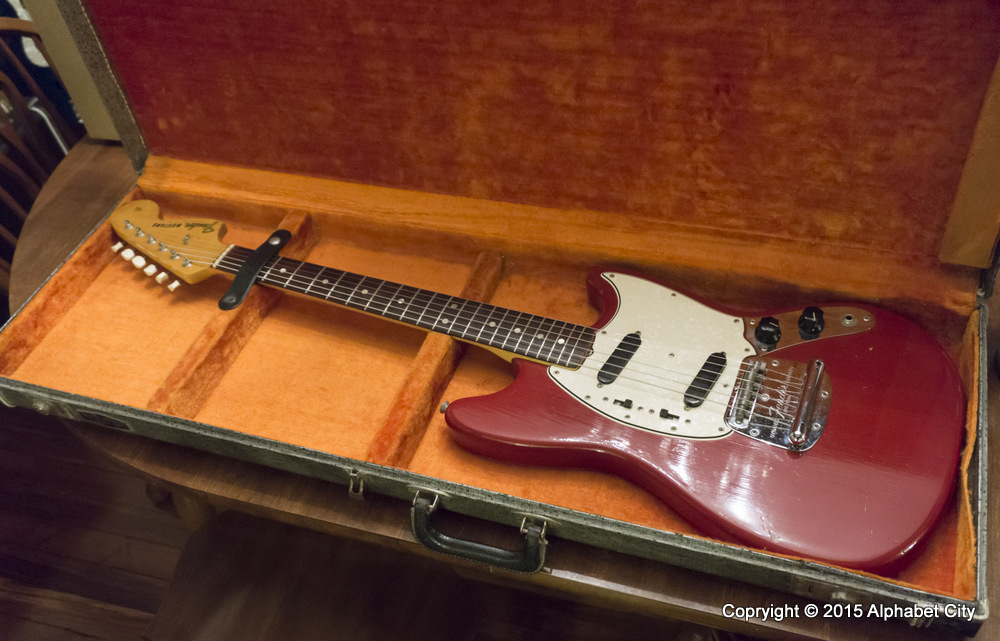
This is my first vintage Fender - a 1966 Mustang:

All original except for the missing tremolo bar (I've since replaced it with a modern one) and input jack. The previous owner kept that in a little baggie so I at least still have it. The tremolo did at least still have its original set screw, so all I needed to do was plug in a new trem bar and lock it in.

This guitar has been well used but not abused - exactly what you want to see in a vintage guitar. The seller was selling it for her son, who she said is a big Mustang fan and owns a bunch more. He obviously loved this one - it's been played a lot and has great wear but it's been taken well care of.

Just look at that freakin' finish checking. This thing has it throughout the entire guitar. It's amazing!

I've honestly never seen such perfect checking.

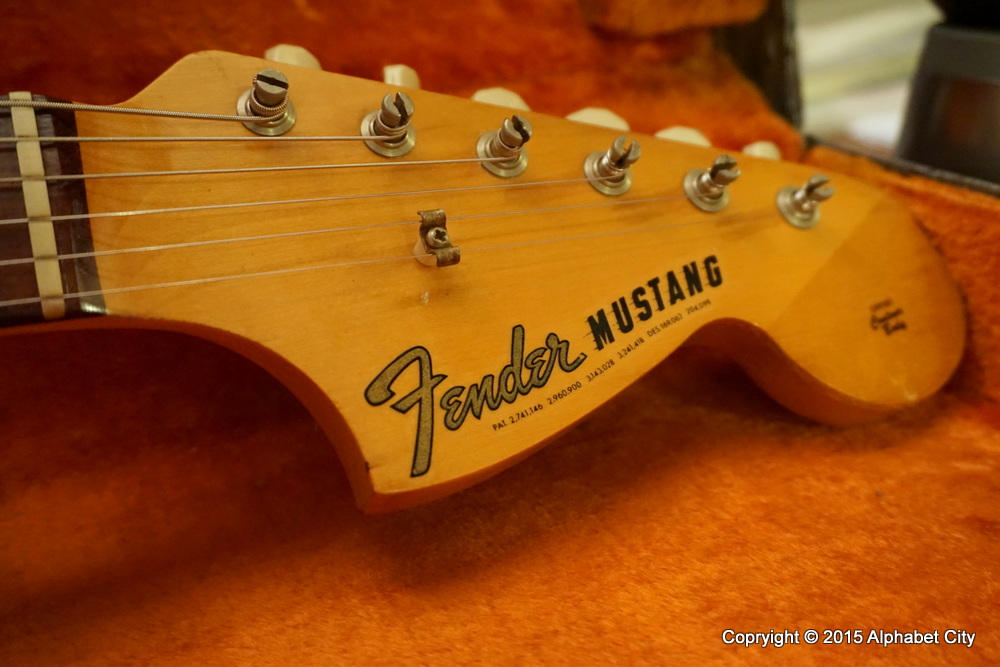
I know how checking in general happens (expansion and contraction of the wood) but I've never really understood how this particular pattern happens to the backs of headstocks. This isn't uncommon, but it's always weird! Nature is not supposed to move at 90 degree angles like that.

The decal is still in pretty much factory shape. I know some don't mind worn decals, but I really like it when they're well preserved.

The neck, fretboard and frets are in great playing condition. The frets are a bit low but still feel fine. I polished them up and they're like mirrors now. No divots, no roughness. This thing is like butter.

One thing I never realized is how subtle vintage pearloid is. I've got a modern Jazz Bass with a pearloid pickguard (oops, never did do a New Bass Day post for that one) and it's got a lot more contrast. Of course it's whiter too. The light is affecting these photos a little bit, but this pickguard definitely is a bit yellower than it probably was when new. It's also shrunk a tiny bit, but there's no cracking or warping.

It's a little hard to see in these photos but this guard is also quite thick, and it's got this amazing hand cut look to it. I don't know how they actually cut these in 1966, but it's got a slight roughness to the edge, and curves that aren't entirely precise. But that gives it a little more of an organic look to me. It's not a computer-guided, laser-cut piece of plastic like modern pickguards (probably) are.

One part that's basically at the end of its useful life: the nut. The slots have been dug in over the years and are way too low. I could fill them and recut, but I'd rather not do that to a vintage nut - I actually replaced this already. (Don't worry, I kept the original one and threw it in the case for safekeeping.) I'll probably do a separate post about that.

The pickups were also a little spotty when I got it - the neck basically didn't work at all unless I pressed and held the switch really hard. A little Deoxit 5 cleaned that right up, though. They work perfectly now.

Case is in beautiful shape too - looks just like how you want a 1966 case to look! Latches still work. No keys, though. If I ever took this guitar out to play, I'd probably buy a cheap modern case to do it with. These cases don't provide a hell of a lot of protection to begin with, and the guitar flops around a bit inside.

When I started looking for one of these, I actually wanted a Competition Mustang - after owning my SCANDAL Tomomi Bluetus bass, I've decided I need more competition stripes in my life. But CompStangs in the color I'm smitten with (orange with matching headstock) are quite rare and therefore expensive. I'm still on the lookout for a reissue Beck Mustang from Japan, which are virtually identical to the original orange CompStangs. I've got the vintage angle covered already, so I don't mind a reissue CompStang. I just need those stripes - they make the guitar go faster.

Nice thing about buying an original Mustang: it weighs 6.6 lbs! I can throw it around like it's nothing. That was kinda the point of these in the beginning, but I've seen later iterations (even from the late 60's and 70's) that weigh 7 or even more than 8 lbs. I've read that if you want yours light, your best chance is with one of the first iteration: that means plain red, white or blue.

I'm sure I'll be posting more about this thing in the future as I work on it. Soon: nuts!

Wednesday, June 17, 2015

NGD: Fender AV65 Jazzmaster in Firemist Silver!

At the risk of guitar posts taking over my blog, I've got at least one more to get out of the way, because a New Guitar Day is always one of the most exciting days of the year!


That's a brand new Fender AV65 Jazzmaster - top of the line - in Firemist Silver with matching headstock. Supposedly there are only 150 of these out there, although you can still find them if you look hard enough. (I'm guessing they're expensive enough that they sit for a while before selling.)

I'm a sucker for matching headstocks and the only other AV65 Fender makes (or has ever made) with one is in Olympic White, which is both incredibly common and incredibly vanilla (literally). So it was love at first sight when I got turned on to the existence of these Firemists - a unique metallic color that's never been mass produced.

When I first opened the case, my reaction was this. In person, it is exquisitely beautiful. It's beautiful in a way that I've never seen a Fender be beautiful before. It's downright elegant. It's the classiest lady at a chic dinner party.

I have an earlier AVRI, the 1962 reissue that was the precursor to the AV65's. I knew that there were a few minor upgrades in the AV65's - a bound neck, redesigned pickups, and a "flash coat" nitro finish that's supposed to wear more like vintage - but I'm surprised at how different this guitar both looks and feels.

The neck is chunkier, for one. And the fretboard feels flatter, although it's not supposed to be - it's probably the binding that's tripping me up. The fretboard itself is bone dry, whereas my AVRI has what seems like some sort of light but hardened oil finish on it. It's hard to tell if the finish on the guitar body is really thinner than on my AVRI, but it does seem to be on the neck, where I swear I can actually feel the grain through the nitro.

I do seem to have a knack for picking up motley guitars, though. It's actually more pronounced in real life than this photo, but my fretboard looks weird:


That's not an illusion or a trick of the light - the left side really is a lot lighter. In sunlight, it almost doesn't even look like rosewood, it's like half of it's maple! I actually think it's kinda cool, though. (In fact, a few days on now, I kinda love it.)

Also, I'm gonna have to update my pickup cover post:


Fender changed the color! These new ones look a lot better - they're more of an off-white than the yellowish "aged white" of the AVRI's. I'm trying to find out now if these have replaced the packaged ones you can buy separately.

Anyway, between my CIJ, AVRI and now this AV65 (not to mention my Mami Stratomaster), I feel like I'm pretty set for life for Jazzmasters... at least until the itch strikes again. Who knows, maybe the next one will be vintage!

Monday, June 15, 2015

I've Spitfired my CIJ Jazzmaster and it is now complete


Ever wonder why modern guitars never seem to look quite right? It's because their pickguards are ugly! Just a swirly brown painted mess. So I've Spitfired my CIJ Jazzmaster:


That's a brand new, handmade tortoise shell pickguard, made the same way the original vintage ones were. It's the closest you're gonna get to the real thing without paying $500 or so. Red Jazzmasters never actually came with these, but it's a common aftermarket look and it was this look that got me into Jazzmasters in the first place.

The contrast in colors on mine is a little strong right now, but that should mellow out over time just as it did on the original vintage guards.

I touched in an earlier post on the fact that modern tort sucks. And there aren't a lot of options for Japanese Jazzmasters - US pickguards don't fit. Spitfire is the only guy making them old-school, with real celluloid patterns churned by hand. And he just started making them fitted for Japanese Jazzmasters.


It's really hard to convey how this looks in person compared to a standard modern printed tortoise shell pickguard. Printed tort has a very "2D" look - it looks like the piece of paper under plastic that it is. A real hand-churned pickguard, though, has truly random patterns all through the material - it has a real depth to it.

Here are a few comparison shots with my old Allparts pickguard still on:


Below is Spitfire, US AVRI, and Allparts top to bottom:


Spitfire and US AVRI below - what is Fender US even doing these days?


Spitfire, US AVRI and Allparts again:


I chose "Vintage Burgundy" for color and "Speckled 60's" for style, because my research showed that that was closest to what was most common in 1966, the year my guitar was based on. Don't like the big splotches of color? Pick "Subtle 60's" instead of speckled. Want something even more dramatic? Go for "Crazy 70's" or even "Solar Flare". Color options also range from "Faded Orange" to "Vintage Dark". The truth is there's no one "right" look if you're trying to replicate vintage - it depends on when a vintage pickguard was made, which individual person made it and how it's been treated since then. Spitfire seems to cover all the possible combinations.

But they all share one thing in common - that look that says you're standing in the middle of an exploding fireball. You just don't get that from printed tort.

Notice too that Spitfire's now using vintage-correct 4-ply thin black line material cut to a wider angle - a seemingly tiny detail that really makes the edges pop (see above!).


Spitfire's pickguards do not come with any sort of shielding material, so on a Japanese Jazzmaster you have to make your own. Whenever you replace your pickguard, do not neglect this step. But I'd protect that signature just in case!


I used the same shielding tape I bought to shield my Jazzmaster's inner cavities. This is probably the best option for a Japanese pickguard, because again, US pickguard shields don't fit and Fender Japan doesn't make one - they use even thinner silver foil tape on their factory pickguards.


Here is it done and trimmed. Truth be told I don't like a lot of wrinkles in my tape and I tried to smooth it out as much as possible while replacing some strips that were even worse than that bottom left corner. (This tape is difficult to keep completely wrinkle-free as you work with it.) Wrinkles that are too deep nearest the edges can leave indentations on your finish over time.

Trimming the tape is tricky - I used an X-Acto knife to trim as close to the edge as possible. I'm sure I scored the back of the pickguard a bit, but who cares - if I ever do sell this, whoever buys it is gonna want that shielding anyway. You need to trim right up to the edge, since you want the pickguard shielding to contact the inner cavity shielding and form a Faraday Cage.

After that, the rest is easy - unstring the guitar, remove the bridge, unscrew 15 screws, remove the knobs, and use a pliers to remove the nut on the pots, switch and jack. Then do the same in reverse. It sounds like more work than it is.

I took the opportunity to replace the rubber gaskets I mentioned at the end of this post with metal washers, as suggested by one of my commenters. I don't know if it made any difference but I had started to notice a bit of buzzing coming from somewhere and I didn't like it.

Outdoor photo of the new guard installed!


This guitar has been an amazing project guitar and I'm almost sad to report that there's just nothing left that I can do to it. All the parts that I *can* change, I have - and in every case, with top of the line replacements. There are just no upgrades left to do, whether functional or cosmetic.

It is at this point, in all honesty, one of the best guitars I've ever played. I have no way to improve it further, and consequently I'm not sure I'll ever write about it again.

But don't worry - there's a new addition to the stable coming this week. More on that soon!


Tuesday, April 28, 2015

The state of the (CIJ) Jazzmaster, April 2015

In memoriam of Fender Japan's closing and in recognition that it's been a while since I posted about it, here's the current state of my Japanese Fender Jazzmaster:


Added a tortoise shell pickguard, and re-added the "aged white" pickup covers that I'd tried out and previously removed.

This is more or less the look that I originally wanted back when I bought this guitar in 2007, but I ended up a little bit smitten with the mint pickguard it actually came with. Still, literally the entire reason I wanted a red Jazzmaster with matching headstock was this:


That's one of Kevin Shields' Jazzmasters, as normally played by Bilinda Butcher in My Bloody Valentine. See it in action in the "Soon" video here:


His, of course, was a vintage Jazzmaster with a vintage pickguard - and as anyone will tell you, most modern tortoise shell looks absolutely nothing like vintage. I have a Japanese Jazzmaster which further limits my options. (An American pickguard will fit with some slight mods, but I don't want to drill either into my guitar or into a vintage pickguard.)

My pickguard above is from Allparts. Yes, Allparts pickguards fit Japanese Jazzmasters without mods - in fact, except for their gold pickguard, that is all they fit. The template they use for most of their guards is Japanese, whether they even know it or not.


It is tough to find decent pictures of tort pickguards online (somehow they all end up a blurry mess), so here's what's hopefully a pretty good shot of the Allparts tortoise shell. It is printed tortoise, meaning there's a clear layer of plastic over what's probably a piece of paper with a tortoise pattern printed on it. From far away it looks okay, but up close it's pretty obvious that there's no depth to it. It's very "2D".

This is true of a lot of modern tort, including Fender Japan's official tort pickguards. (Their early pickguards were red printed like this, although I think the Allparts looks better. Their later tort pickguards were brown, but still printed.) Fender's new US pickguards don't look printed, but they're also not "real" tort - they look like they're made with some variation of the swirl painting technique, the same way their "bowling ball" guitar finishes were made.

There's one guy who's figured out how to make real celluloid tort again, just like the vintage stuff, and his nom-de-plume is Spitfire. If you want a vintage-looking pickguard without spending $500+ for one, he's your guy - as long as he's got a template for your guitar. A long time ago in a thread on a guitar forum I read he posted this kind of amazing video about pens, and it seems like that set him off and running. This is how you make real tort:


I'm literally counting the days until he sorts out his Japanese Jazzmaster template, which he's apparently in the process of doing. My Allparts guard is a placeholder.


I'm not sure if you can tell (it's more obvious in the photo at top), but in person I still feel like the pickup cover color is off. See, those knobs there aren't the modern reproductions - those are real vintage knobs from 1966. That's the color they've faded to, not the yellowish brown that Fender's "aged white" really is. Granted, not everything would have discolored at the exact same rate, but usually most of the plastic on any guitar matches.

The stark white Mojotone covers I had, though, didn't look right either on a tort pickguard. I felt that way with my AVRI also; tort needs something a little softer.


My phone whitened up the pickup covers in this photo - damn, I still think this is a beautiful guitar. Just can't wait to slap a Spitfire guard on it!

Wednesday, March 11, 2015

Planetwaves Fret Polishing System - works good!

Every guitar eventually ends up with frets that are dirty, dull or even rusty. This is at best unsightly, but it can also make playing harder because the strings can't slide along the frets as easily. There are a bunch of ways you can polish them up, from steel wool to a Dremel to just taking your guitar in to a tech who (hopefully) knows what he/she is doing better than you do. I've tried a few methods myself but today I want to talk about the one thing that really worked for me: D'addario's Planetwaves fret polishing system.


You'll notice that I'm working on my Scandal Haruna signature Telecaster. This is a cheap Indonesian guitar that obviously didn't go through a very good QA process, and mine had rusty frets right from the factory.


The Planetwaves system is basically just a few sheets of extremely fine-grit sand or fiber paper combined with a cutout cardboard fret guide to keep you from sanding your fretboard by mistake. Extremely simple, but that pleases my inner engineer. It also pleased my wallet, because the system costs about $5. It almost seems like something that cheap couldn't possibly be effective.


But it is! It may be a bit hard to see, but first, you should be able to make out that the left half of my frets above are mirror-like and silver, while the right half are still dull and brownish. Yep, I was about halfway done here. Also look at the paper - those black marks on it are rust from my frets.


This is the finished product. It's perfect! I really could not be happier with this system. It does restore your frets to a mirror shine as it says it will.

I later did the same to my Japanese Jazzmaster, which I play most often and its frets seem to dull quickly for that reason. It was a little harder to get them to a mirror shine, but I think that's because of the nature of their dullness, which is from tiny microscratches that accumulate through playing. This system seems to more easily handle dirt or rust than regular fret wear, although it did still help even on the Jazzmaster.

It does take some elbow grease. If you try this, don't give up after just wiping your frets a couple times. You really need to get in there and scrub back and forth vigorously. But the results can really be satisfying.

Friday, November 07, 2014

Finally - the Haruna "Skullsilver" Telecaster reviewed!


Closing out my reviews of the three Scandal signature guitars is what for me was the holy grail - Haruna's "Skullsilver" Telecaster! See my earlier reviews of Mami's Stratomaster and Tomomi's Bluetus.

HARUNA'S SOUND
The first time I saw Scandal in person, I was shocked by how thunderous Haruna's tone was. You get this a little bit on the albums but her sound is just murderous in person - it shakes your whole body. This doesn't usually come through even on their own live DVD's.

Mami plays higher up on the neck and mostly uses her bridge pickup, which gives her a trebly, twangy sound. Haruna's sound is bassy and powerful - in person it's like a kick in the gut, but that's hard to reproduce on video. Haruna's sound is the foundation of the entire band, and it's a lot heavier live than it is on the albums.

Haruna's said in interviews that she intentionally picks guitars with humbuckers for that thick sound. But after debuting at Budokan in 2012, the signature "Skullsilver" has become her main guitar. She always opens and closes shows with it, and she uses it for all but a few songs. Mami and Tomomi, by contrast, seem to only play their Squiers as much as they're contractually obligated to. Of all the signature Squiers, Haruna's is the most iconic simply because she really plays the hell out of it. It's rare these days to see her without it.


DESIGN AND PICKUPS
The design of the Skullsilver Tele seems loosely based on the Blacktop Telecaster but with a 21 fret neck and a basswood body. It also has witch hat knobs with numbers facing the right way, which the Blacktop does not, and oddly enough Haruna's prototype doesn't either! (Hers uses amp knobs; the production Skullsilver Tele uses aftermarket guitar knobs.)  Otherwise, though, the production guitar has the same unique "backwards" control plate and the same pickup configuration.

About those pickups - Fender's spec page lists Blacktop pickups as "Hot Vintage Alnico Humbucking" pickups, and these at least look the same. It's possible Haruna's using the stock Blacktop pickups. These guitars are part of a marketing deal with Fender so they'd want to keep them at least looking stock, but the high output of these pickups do match her sound.


This is the contents of the box from Ishibashi. Guitar, allen wrenches and product card, and mostly useless Squier gig bag that's good for storing your guitar in the closet and not much else.


Haruna Tele Dark Silver Sparkle. More on that color and finish in a minute.


The guitar removed from its protective covering. The plastic had started removing itself from my pickguard, so I immediately took it the rest of the way off. Incidentally, the plastic used in these pickguards is extremely soft and will scratch if brushed by a stiff wind. This is definitely not the case with Haruna's own guitar, but mine became unsightly after only a few weeks of playing. I haven't yet found a replacement that fits either - if you're curious, the Blacktop pickguard does not.

DAT SPARKLE FINISH
I was happy to see that there were no major finish blemishes or other problems with the look of my guitar. I saw one of these hanging on a wall in Japan with what looked like a damaged skull decal under the clearcoat, and I've heard from others who have had minor problems with theirs as well. Sparkle finishes are not easy or cheap, and in a $400 guitar it's almost amazing to get one this good. Mine is completely perfect - I see a couple spots in the photo above where it looks uneven, but that's just my shadow on the guitar. It's a surprisingly flawless finish.


Here's a closer look. It probably goes without saying, but in case you're new to electric guitars, all of Scandal's signature guitars are clearcoated in poly. (I'm not sure if it's polyester or polyurethane, but there's not much distinction there.) This is typical of cheap guitars - it's an easier top coat to apply than the more traditional nitrocellulose, which has a more refined look.

It's hard to see above but the bridge saddles are all actual Fender bridge saddles. That makes me wonder if the bridge itself is too - I don't have enough experience with Teles to know for sure. My old Squier Standard Strat definitely did not come with Fender saddles or a Fender bridge.

I've been lucky enough to see Haruna's own guitar in person three (update: four!) times. I wouldn't say the production model finish is an exact match, but it's closer than I imagined when I saw the initial PR photos vs. the real thing.


Haruna's own guitar has big sparkle flakes, which makes it almost blindingly bright in direct light. It's like a mirror when it catches the light right. But those big flakes are harder to do, and consequently more expensive. For the production model, Squier seems to have gone with smaller metal flakes on a grey base, which dulls the finish a little bit but keeps costs down.


OTHER LOOK & FEEL
The front of the headstock. The maple is nicely tinted and, like my other two Scandal guitars, they picked a nice tree from which to cut mine. It has a much classier overall look than my Squier Strat.


Back of the headstock complete with Haruna's stamped signature. I'm guessing these are the same Gotoh-made Kluson-style tuners used in both my American and Japanese Jazzmasters. (It looks like there's a tiny chip right at the middle bottom of the headstock above, but it's actually just a spec of dust.)


Here's one annoyance - Squier used rusty fret wire to fret my guitar! I'm going to need a fret polishing before this thing is even fully playable. It's also a bit unsightly just hanging on the wall. Again, as I mentioned in my Bluetus review, I don't expect high-end specs or features in a $400 guitar, but some basic quality control would be nice.

If you're interested in how I dealt with this, check out my Planetwaves Fret Polishing System post.

The neck itself is surprisingly chunky. I'm not sure how this compares to the real thing and I'm not normally a Tele player, but it's almost a Gibson-like neck profile. I personally prefer a flatter neck profile and I'm surprised if Haruna really prefers such a fat neck with such small hands, but every guitarist has their own tastes. (My wife is the same - small fingers, fat guitar neck. I don't get it.) The guitar itself also feels quite thick and brickish, which I don't remember other Telecasters I've played feeling like, or at least not to this extent. It feels like it would make a really good life raft in an emergency. The body is at least contoured on the back for comfort (like the Blacktop).

The fretboard radius looks like 9.5", which isn't my favorite radius, but it's common to most modern guitars.

FINISHING UP
This is the one guitar with Gibson-style humbuckers that I own and I'm glad to have just one. Give it some distortion and it sounds like a pointy metal guitar (or a Les Paul) but without the 80's styling. And it does sound very much like Haruna really sounds when played loud enough and with enough distortion.  (And the right kind - see my OCD below!)


Scandal tribute concert at my house!

I doubt any of these signature models will take over from my Jazzmasters as my own main guitar, but I am happy to have them. They really look very close to the real guitars, and they all play well in their own right depending on what you're after. They do all have some minor QC issues and interesting specs married to mostly low-end hardware and electronics. They are beginner guitars that look really cool and mostly sound good (I'm still iffy on Mami's bridge pickup, which is supposed to be that guitar's big selling point). I think they're all good values even without the Scandal connection, but as a fan, I almost feel like the band themselves are here whenever I look at them. I'm a happy collector!

UPDATE 04/06/2015: Shock and horror!


I keep discovering weird random problems with all of these Scandal guitars. The latest one with the Haruna Skullsilver Telecaster is this - notice that one of the ferrules above seems empty? The string end has literally punched right through the ferrule and is now resting against the back of the bridge. It seems to have been this way since manufacture, since I've never changed the strings and the A string appears to still have its original "wrap" around the tuner peg. They did this at the factory, and nobody bothered to check or fix it.

I've got some new ferrules on order, but this is a serious annoyance that I shouldn't have to deal with. I've never heard of a ferrule failing like that.

UPDATE 05/08/2015: Fixed.


First, this is a normal ferrule on the left, the defective one on the right. They somehow made it that way, and nobody noticed it when they strung the guitar up in Indonesia.


I had to try two sets of replacements before finding one that fit. (For the record, American Standard Tele ferrules are too small.) I ended up buying a cheap set from Ebay that were listed specifically as 8mm. They're a little more chrome than the nickel they should be, but I don't really care, and if I ever sell this thing, I'll keep the originals in case anyone wants them.

Incidentally, getting the original ferrules out was a bitch, and getting the new ones in was too. I finally jury-rigged a system made up of the straight part of a thick wire hanger, which I cut with a Dremel, and a rubber mallet. I then removed the bridge and tapped the ferrules out from the front. Some of the new ones fit the existing holes perfectly, but a couple required shaving the inside of the hole a little bit (again with the wonder-tool that is the Dremel).

Well, anyway, everything's sorted now and this is finally a playable guitar.

05/09/2016 UPDATE: I sold my original Skullsilver (the one detailed above) as part of the full set, and wanting to still have one Scandal guitar, I bought another from the second production run. One change is that the standard gig bag is much better now.


That's Skullsilver #2 in the new gig bag. I'd call this gig bag actually usable. They may have done this because there was no special run just for the Kitty store this time, with the upgraded gig bag featuring the Scandal logo. (See my Mami Stratomaster post.)


This is the only gig bag you can get with these now. It just has the regular Squier logo, but it's a nice bag.


I'm not sure, but I feel like something's different about the finish. It may just be that a larger number of flakes in this one are standing up at odd angles, which leads them to look black unless the light is hitting them just right. (You see some of these in the photo above.) But I also feel like I see more grey in this finish. It's a little less striking than my original one, somehow.

I also don't remember my original one being quite so noisy, like it's missing some kind of shielding that the first one had. I'll need to take care of that if I ever decide to play this guitar enough to even take the plastic off!

Then again, it doesn't have the quality control issues of the first one. There's just a lot of variation in these in my experience, including what I've seen on my trips to Japan. Maybe you'll get one with an amazing finish and some defects, or no shielding and no defects, or an imperfect finish but perfect sound. It's just kind of a crapshoot with this Indonesian factory.

About This Blog

This is increasingly not a blog about Alphabet City, New York. I used to live in the East Village and work on Avenue B, but I no longer do. Why don't I change the name if I'm writing about Japan and video games and guitars? Because New Yorkers are well-rounded people with varied interests, and mine have gone increasingly off the rails over the years. And I don't feel like changing the name. I do still write about New York City sometimes.

Followers

  © Blogger templates The Professional Template by Ourblogtemplates.com 2008

Back to TOP