Showing posts with label japan trip 2012. Show all posts

Monday, April 09, 2012

Japan trip 3/2012 - the roundup


I love the blog format but it's annoying how there's no good way to organize things by tag in Blogger. (Clicking a tag just acts as a filter on the main blog page.) So now that I'm basically calling my latest Japan trip report done, here's my manual post roundup - now in forward chronological order:

And some extra posts:
I'm always a little sad to be done writing - the trip is really in the past now. And this was one of the more fun ones we've had. We did even more stuff too (I was actually there 8 1/2 days and took 1,183 pictures), but believe it or not, I don't write about everything!

If you're interested in these posts, keep checking back because next up is a top 10 list of everything I've ever done there, in 13 years worth of visits. At this point my wife and I have tried pretty much all the major tourist attractions (in Tokyo) and even many things off the beaten path, so I think it'll be useful for those planning a trip to see what's really worth it and what isn't.

Saturday, April 07, 2012

Random thoughts and picture dump: Japan trip 3/2012

It's about time to just do a little cleanup - some little snippets of thoughts and photos I took over the past couple weeks that didn't fit anywhere else.

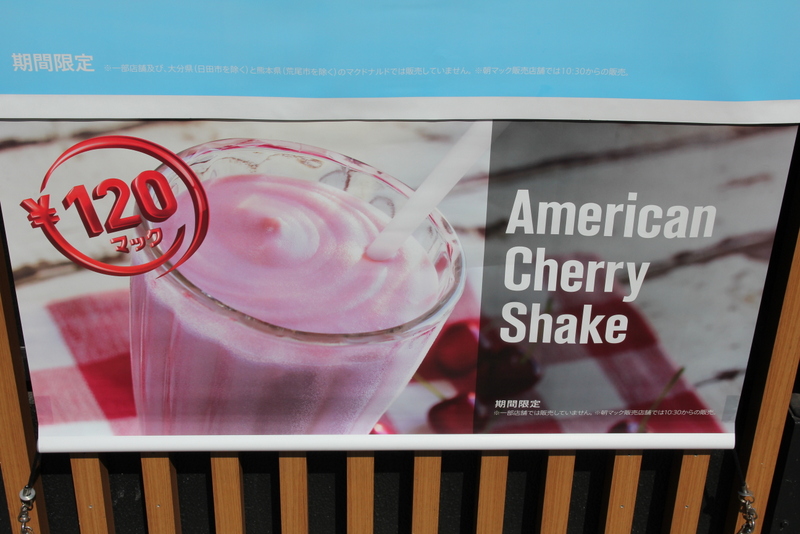
Apparently, "American cherries" are just black cherries. Still something funny about it to me.

Lots of these in the subway this time. Eventually they'll be all over Japan, to prevent scenes like this.

Why a picture of some random mall? It's not a mall, it's Haneda Airport! Actually one of the more impressive airports I've seen - way more interesting than Narita.

Do not taunt Crunky Ball.

Lots of these signs around Tokyo, to thank everyone for the support after the earthquake.
(I hadn't noticed the "no goods, no life" sign in the background until now.)

If I ever move to Tokyo, I want to live at the Hanzomon Bain-Douche.
That can't possibly be a name.

Some Japanese cities have these crazy streets that they've blocked off to traffic and stuck a roof over. They go on forever, and the weird thing is there are still cross streets going through this (still under the roof), with walk signals that you have to stop at. It's like being in a mall, and then all of a sudden there's a stoplight with cars coming at you.

One of Hiroshima's old streetcars - I love these things.

Mmmmmm, unlicensed Totoro cake.

This was a crazy bridge at Miyajima's shrine - how do you even use this?? The weird thing was there was absolutely no apparent reason it needed to be built this way - there was just flat land under it.

I showed Haneda airport's observation decks earlier; Narita has a couple as well. (This is not the best one.)

The Grand Prince Akasaka, which I've stayed at twice, is now a ghost hotel. Wonder what they're going to do with it.

The view, again, from our room at the Grand Arc Hanzomon. I love this view; it has everything you could hope to see in Tokyo. Tall buildings (for Tokyo), Tokyo Tower, even a moat. How many hotels give you a view of an honest to goodness moat?

My wife was impressed with the fact that Haneda airport's bathrooms have monitors in the stalls.

Of course I ate my share of McDonald's on the trip - that's how I know I'm in Japan! They still make the best teriyaki burgers. That's a little American Cherry Shake on the left. It was good!

My wife's Beverly Hills Burger was nasty, though. I tried it. Blecch! Avacado and egg do not belong together on a hamburger.

If this pic doesn't look crazy to you, look closer. This is basically an escalator... that's flat! It's like some sort of practical joke, or the beginning of a cartoon punch line.

You can get bagels in Japan, though they're weird. This is a green tea bagel.

You may have heard of Book-Off, Japan's big used bookstore chain. But now they have "Book-Off Bazaars", which have used everything. It's basically just a giant thrift store. This is now my favorite chain of stores in Japan. These are like the size of an average Wal-Mart, and all they have is used stuff of all kinds. It's like if Ebay opened a store.

Yes, that's me walking towards it. (I feel like this looks like a still image from a film about a terrorist who walks into a crowded store and mows everybody down with a machine gun.)

A couple other random thoughts:
  • I always forget how sick everybody constantly is in Japan. I don't just mean the number of people wearing masks, which is inflated right now because of radiation fears. I mean people actively hacking up mucus all over the place. It always seems to be about 40% of the population whenever I visit, and many of them don't wear masks. I now have a cough myself that I'm convinced I got from someone there.
  • This was my first trip to Japan where I didn't need three changes of clothes per day due to sweat. I've always gone in summer before. Everywhere felt a little weird to me as a result; there's a different energy in a city in early spring vs. late summer.

Friday, April 06, 2012

Japan Rail Pass and getting around: Japan Trip 3/2012


I actually love traveling within Japan - unlike the United States, they have not seemingly gone out of their way to make travel the worst experience possible, and consequently people in Japan travel more than we do. I don't generally fly domestically in Japan because it usually doesn't make much sense, but taking the train is fast, convenient, comfortable and really interesting. It's just pleasant, and even fun.

If you've ever gone or planned to go to Japan, then you probably know about the Japan Rail Pass, which gets you a free ride on most JR trains throughout the country, some buses and some ferries. A lot of people recommend it to all tourists as just a matter of course, but I actually don't think it makes financial sense most of the time. It's not cheap, and unless you're planning to visit two or more cities far apart in a short period of time, you're probably not going to make up the cost.

I've been to Japan about 12 times now but this was the first time using a Japan Rail Pass. The math just never worked out before. But we were planning to do a round trip from Tokyo to Hiroshima, and that alone makes a rail pass worth it since the ticket alone costs more than a rail pass.

So we bought a couple for ourselves, and with the savings, we upgraded to a Green Car rail pass.

Here are a couple tips for the rail pass right off the bat:
  • If you get one, maximize the value - stay at a hotel on a JR line (like the Yamanote line).
  • Buying a green car pass has added benefits, like fewer sold out trains (so you can book last minute).
  • Plan your expensive rail trips so they fall within the 7 or 14 day period the pass is valid.
  • You can select the date your pass validity starts; just tell the JR people when you get it, it doesn't have to start on the same date.
  • Remember that even with a Green Car pass, you can still only take the second express tier or below of shinkansen service.
When you buy a Japan Rail Pass, you first get this:


That's an exchange order; it looks kind of like an old paper airline ticket inside. This is not a rail pass! It will get you nowhere. When you get to Japan, you need to go to a JR ticket office in a major location like Narita Airport or Tokyo Station and exchange it for this:


That's a rail pass. It's pretty snazzy; makes a good souvenir (oh, but you will mess it up through use). Has an embossed metallic look to it. Not sure if that's just for the Green Car passes or if the ordinary ones look the same. (2015 update - see the bottom of the post for an answer to this!)


With the Japan Rail Pass, you can basically just hold your pass open and sail right on through any manned gate at any station. They really just look at the date (in my case, that's the "24 3 31"). For the shinkansen, you do still need to go to a ticket office and get a reserved ticket - though it is free. Japan Rail Passes are non-refundable and again, they are expensive, so I found myself holding onto mine like grim death most of the time. I was constantly checking to make sure I knew where it was.


Here I am with my "Tokaido Shinkansen Sandwich" in one hand and my rail pass in the other. I am holding the rail pass in about 85% of the pictures my wife took of me in Japan. That's about $450 in my right hand, I didn't want to lose it!

We got 7 day passes, which was kind of an issue because we were actually in Japan for 8 days. So we decided to start it on the 2nd day, knowing we'd be taking the shinkansen back from Hiroshima on the 8th day. That meant paying for our own transportation from Narita to Tokyo. JR operates the Narita Express (N'EX), but it's expensive if you have to actually pay for it like we did. We ended up taking the Keisei Skyliner, which runs a similar express route but terminates at Ueno (marginally less convenient) and costs half the price. It's a pretty cool train!


Kind of plasticky inside, but still comfortable. Japanese trains all have ridiculous seat pitch. They're shorter than we are on average but they love legroom.

Because our hotel was situated on the Hanzomon line, most of our traveling within Tokyo itself on this trip was actually via the subway - we chose a hotel we liked rather than one that would maximize the value of our rail pass.


Some people say the Tokyo subway is confusing, with its spaghetti-like tangle of lines, some of which are owned by different companies. I'm used to the NYC subway and find Tokyo's pretty easy, though. If you really aren't sure you can figure out a major subway system like this, it pays to just get a good guide book to carry around - because you'll be using it a lot. The subway is the primary way people get around in Tokyo, although you definitely can use JR lines more often if you pick the right hotel and want to use your rail pass.


Having a Japan Rail Pass opens up a new world of about a 300 mile radius around Tokyo to explore. That's how we ended up at the SC MAGLEV and Railway Park; that was an unscheduled day trip to Nagoya via shinkansen that we wouldn't have taken if not for the rail pass. With a rail pass, your constraint is no longer money but time, and the shinkansen trains are fast enough that you can travel a long way, do something in another city, then be back in Tokyo in time for dinner. That's something we hadn't considered on previous trips - it really does give you a lot more freedom.


Traveling by shinkansen in Japan is almost always a great experience. Every major city has a huge centrally located train station, often within walking distance of major hotel clusters. If you choose your hotel right, you can be in your room at 9AM and be on your shinkansen train for a day trip at 9:10. If you're hungry, you can buy a bento box like this directly on the platform:


They come in different types - you can even get sushi! These are made fresh every day, so you don't need to worry.


If you don't buy something at the station, there are car attendants that come through with food carts during the trip. They come through a little more often in the green cars.

There is no security to deal with, and the trains themselves run on time to the second (except when there's bad weather). Most of the time, the train is very quiet - especially if you get a green car. Ordinary cars come sometimes be a little raucus if there's alcohol around (and there often is), but usually the Japanese adhere to the societal norm that all train cars are considered "quiet cars". That means no cell phones, no music playing, no loud conversations.

A little story. On one of our legs this time, there was a group of four people a couple rows in front of us, all businessmen apparently working on the same project. Two were German and two were Japanese. The German guys were carrying on as if they were outside; I felt like I was part of their conversation, they were so loud. At one point, they stood up to talk over the backs of the seats to the Japanese people in their party, who were sitting in front of them. One of the Japanese guys actually ended up telling the Germans to basically sit down and shut up. (A little more politely than that, but that was definitely the gist.)  So, if you're planning a trip, just be aware that this is the custom in Japan. Traveling by train is a shared experience and you are not supposed to impose yourself onto others in the train. You will even hear announcements to that effect in English on most trains.


The seats on the shinkansen trains are extremely comfortable (a little moreso in the green cars), and as a 6'4" guy, I have no problem at all - there is plenty of room even to cross my legs. Like American trains (actually even moreso), the seats are actually much bigger than on airplanes so if you're used to seeing airplane seats, it's hard to get a sense of scale from the photo above - there is a lot of legroom. Trains are also designed so the windows exactly line up with the seats, so even though the newer trains have smaller windows, you're still not lacking for a view.


My big pet peeve with the green cars in some of the newer trains is the footrest, which you can't move out of the way and which takes up a lot of floor space. I think the whole idea of "footrests" is stupid - there is already a perfectly good footrest, it's called the floor. I don't see the point in raising my foot 6 inches higher. All the footrest ends up doing is making it so I can't fit my feet under the seat in front of me and really stretch my legs.

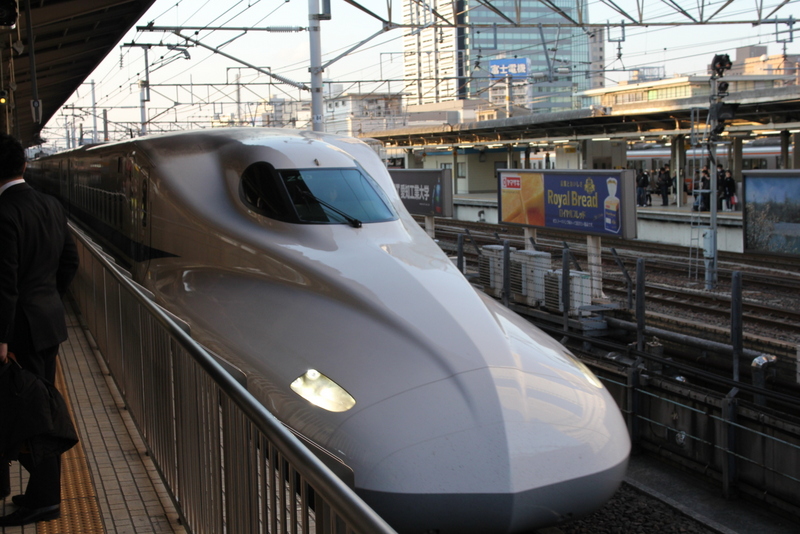
I didn't take pictures of it, but the new N700 trains all have power ports at every seat in the green cars, so you can plug in a laptop or charge your cell phone. The slightly older 700 series trains don't have this, but their footrests are slightly smaller so at least there's that. For you trainspotters out there, the Tokaido line is now pretty much entirely 700 and N700 trains, which is kind of boring, but if you go past Osaka, you'll still see the occasional 500 series or even earlier. On the Tokaido line, the N700 trains are mostly used on Nozomi services, so be prepared to deal without seat power if you're riding with a rail pass.


Yes, you do get some spectacular views from the train.

I'll close with just a little bit more about weather. Japanese trains have a deserved reputation for punctuality, but just beware that they do not run equally well rain or shine. In fact, three times now in my twelve or so trips to Japan, we've had major disruptions to our travel plans due to weather. At the end of our trip this time, a freak storm basically knocked out a bunch of lines around Tokyo, including the Joban Line we were trying to take to Sanuki station about 60 miles north. Shinkansen service was also delayed. My wife said it was her worst train experience ever in Japan; we were literally sitting motionless on a train that never left the station for an hour. We then switched to another train that was announced as leaving next, but didn't. We switched to a third and finally got as far as Toride before the train terminated. We had to drive the rest of the way.

If you by chance read my "soundtrack to Japan" post, the pics I took of the AKB48 omiyage box at the end of that post were just me killing time sitting on a stuck Joban Line train. It does happen, even in Japan.

2015 UPDATE: Here's an "ordinary" car rail pass:


No embossing, no metallic paint. Just plain matte paper. Not nearly as cool! My wife thinks they just changed all the passes, and I concede it's been a few years since the rest of this post. But I think there probably is a difference between the green and ordinary passes.

Thursday, April 05, 2012

Miyajima Island and Hiroshima Castle: Japan 3/2012 Day 7


I wrote earlier that there's not really a lot for tourists to do in Hiroshima besides visit the Peace Park, but one thing that's almost another obligation is Miyajima. This island is famous for the Itsukushima Shrine with its "floating" bridges and main island gate, and you see pictures of it all over the place any time someone wants to show a stock view of ancient or traditional Japan. (I believe the gate is even featured in one of Windows 7's default desktop wallpapers.) People will think you're an idiot if you go to Hiroshima and don't visit Miyajima - it's the city's one big non-bomb related tourist attraction.

Getting to Miyajima requires either a very, very long streetcar ride or a slightly shorter ride on the JR Sanyo line, either one of which leaves from Hiroshima Station. Then you hop on the ferry for a short ride across the water to the island. If you have a Japan Rail Pass, the entire trip (including ferry) is free, unless you take the streetcar, in which case it does cost a little money. We actually took the JR line one way and the tram back, because we planned to visit the Peace Museum and Hiroshima Castle afterwards and the tram stops nearby.

The JR Miyajima ferry.

This is a Hiroshima streetcar, though not the one that takes you to Miyajima.
I just like the old ones better, so that's what I have pics of.

Because Miyajima is about an hour outside of Hiroshima City, it was apparently unaffected by the A-bomb. Few traditional temples and shrines in Japan have been untouched since being built, though - they've all been rebuilt multiple times just because they wear out. So even though things look old, and are by American standards, you're usually not seeing pre-medieval artifacts like you might expect. Most of what you see at Miyajima is only a couple hundred years old at most, and some areas are brand new or even under renovation right now. (Hey, it's a wood shrine that's partially submerged in saltwater for half the day; it's not going to last forever.) Just look at the floor boards and railings in the pics below, and of course there's constant painting going on.

Souvenir ticket.


Miyajima's big claim to fame is that its shrine appears to be floating in the water during high tide. Unfortunately for us, we visited during low tide so the illusion was kind of lost on us - its buildings are built on stilts on landfill. It's still a beautiful shrine.


Walking around Miyajima is almost like being in a petting zoo. Deer are considered sacred and there are many of them on the island - and they are used to humans. They will walk right up to you if they're hungry (and they do want your food), and if they're relaxing, they will stay in place if you approach. And yes, you can pet them - although we didn't, because the island is very dusty and many times the deer seemed to be laying in their own poop. We saw plenty of other people petting them, though.


Like at a lot of the more touristy temples and shrines in Japan, there's a cottage industry of souvenir shops and food stalls that have popped up around the island. I'm kind of ambivalent about this. On the one hand, most of what they sell is cheap junk and "Hello Kitty Miyajima" merchandise. On the other, there is food like this:

Oysters, which are a Hiroshima specialty. My wife said these were the best she had ever had.
Not a big oyster eater myself.

Deep fried momiji-manju on a stick! These were soooooooooooo good.

Momiji-manju are another regional specialty - basically a soft maple leaf shaped little pastry stuffed with some sort of gel-like sweet substance. Traditionally it's azuki bean but these days you can get them with chocolate, custard, cheese and a bunch of other things. You can get them all over Hiroshima. Honestly, I can't really recommend one place over another - they all seem pretty good. We only saw the deep-fried ones on Miyajima Island, though. This is their version of a deep-fried Twinkie.

Regular (baked) momiji-manju.

Momiji-manju making machine. You can watch them bake right there, then eat them.

On our way back, we hit the Peace Museum (already written about), the big Book-Off that Hiroshima has, and then Hiroshima Castle. We actually just missed going into the castle - it closed right when we got there - but we saw it from the outside and walked around the grounds.

That is actually the guy inside closing the door to the castle for the day.

Hiroshima Castle is a replica of the original, which was destroyed in the atomic bombing. Many of the buildings on the grounds have just been left as ghostly foundations, but the castle itself was rebuilt in its original style, as were the main gates.


The bridge going into the castle grounds was obviously just rebuilt again, and it's really interesting to see brand new construction in the old world style. Japan is a really modern country but there is a lot of ancient knowledge that has never been lost, and they still know how to do things the same way their ancient ancestors did. I feel like this is actually important - this adds something to the cultural psyche that we in America just don't have. Japan has strong ties to the values and traditions that formed the country thousands of years ago (for better and worse), and this gives them a kind of cultural stability that the United States lacks. We as Americans have no shared cultural foundation; we're still making it up as we go along, constantly searching for something to bind us and increasingly not finding it. I guess this is why Japan makes sense to me in a way that America doesn't.

On the way back to our hotel we stopped for more ramen at the train station:


It was similar to the ramen I'd had the night before. Very thin noodles, Hiroshima style. Nothing on this trip compared to the best ramen I'd had on previous trips, though.

This was basically the end of the vacation part of the trip. The next day we headed back to Tokyo, then off to do some family stuff for a couple days before heading back to New York. This won't be my last post, though - I've still got a few posts on particular topics and then a random roundup post I'd like to do, so still a few more coming!

About This Blog

This is increasingly not a blog about Alphabet City, New York. I used to live in the East Village and work on Avenue B, but I no longer do. Why don't I change the name if I'm writing about Japan and video games and guitars? Because New Yorkers are well-rounded people with varied interests, and mine have gone increasingly off the rails over the years. And I don't feel like changing the name. I do still write about New York City sometimes.

Followers

  © Blogger templates The Professional Template by Ourblogtemplates.com 2008

Back to TOP