Showing posts with label japan trip reports. Show all posts

Thursday, December 10, 2015

Staying in Odaiba - my favorite part of Tokyo


I've written about Odaiba several times before - including visiting Sega Joypolis (twice), riding Leiji Matsumoto's Himiko boat, the Daikanransha ferris wheel, and eating the best ramen in the world. There's a lot to do in Odaiba!

This trip, my wife and I finally decided to stay there. We booked a room at the Oakwood Ariake - in fact a "suite", because Odaiba's far enough afield (especially the Ariake neighborhood on the "far" side of the island) that rooms are super-cheap.


We love Oakwoods because they're "apartments" rather than "hotel rooms", so you get both a full kitchen and this:


A combo washer/dryer - really handy!

This was "only" $160 per night - I know, to someone from the midwest USA that probably sounds like a lot, but in Tokyo it's kind of a bargain - about the average price for a tiny single room. Even in New York, that'd be a cheap room - and we had a separate living and sitting area, plus the kitchen and washer/dryer. Oh, and a balcony, which is something we always look for now that we're old and spoiled. The view was interesting, but for $160 per night you're not going to get the same view as the $430 per night Prince Park Hotel. (Seriously, click that link if you're not a regular at my blog - no other hotel has a view like that.)


Still, we really liked this view - it had a lot of movement. That's the Shutoko Expressway on the left, and the Yurikamome train cutting across over the top. (The Rinkai line station is the chuckwagon looking thing near the center of the photo.)

My two favorite things about Odaiba are how much there is to do for fun, and conversely just how quiet it is, with wide open spaces:


It just does not feel like what most people think of as Tokyo, even though it totally is. It's in Minato, one of the 23 special wards that make up the central city. By the way, that's our hotel in the middle left.


This wasn't at like 4 in the morning. This was dead middle of the afternoon on a weekday. Sometimes I actually kinda worry about Odaiba - it doesn't feel like there are enough people to sustain all this. But it does get crowded sometimes, in certain areas. Weekends and nights are a little more crowded in general than the daytime.

Still, it's like an oasis in an overcrowded city. Coming back to this after spending a day in "mainland" Tokyo is really relaxing. And it's still Tokyo, so you never feel unsafe even in deserted areas.

We've always avoided actually staying in Odaiba because we (along with a lot of other people) think of it as the middle of nowhere. But it has all you need - everything's just hidden. There were about ten different convenience stores surrounding our hotel, a McDonald's, and both the Rinkai and Yurikamome lines within easy walking distance. The Rinkai line is ridiculously easy to get to most tourist areas on because JR Saikyo line trains also run on it, and the Saikyo line stops in Shibuya, Shinjuku and generally parallels the Yamanote line that loops around the city, making it easy to transfer. So everything worked out even better than we expected - 20 minutes and we could be anywhere we wanted to be, and coming back at any hour, we were still able to pick up a bottle of wine or two or three between the station and our hotel.

Of course, it was also nice being able to walk to the stuff we wanted to do around the island:


Two concerts, both walking distance to our hotel. Zepp Tokyo is directly under Daikanransha:


DiverCity is one of the many malls in Odaiba - it is really American:


You may as well be in New Jersey. Oh, except for the giant Gundam right outside.


That's pretty Japanese.

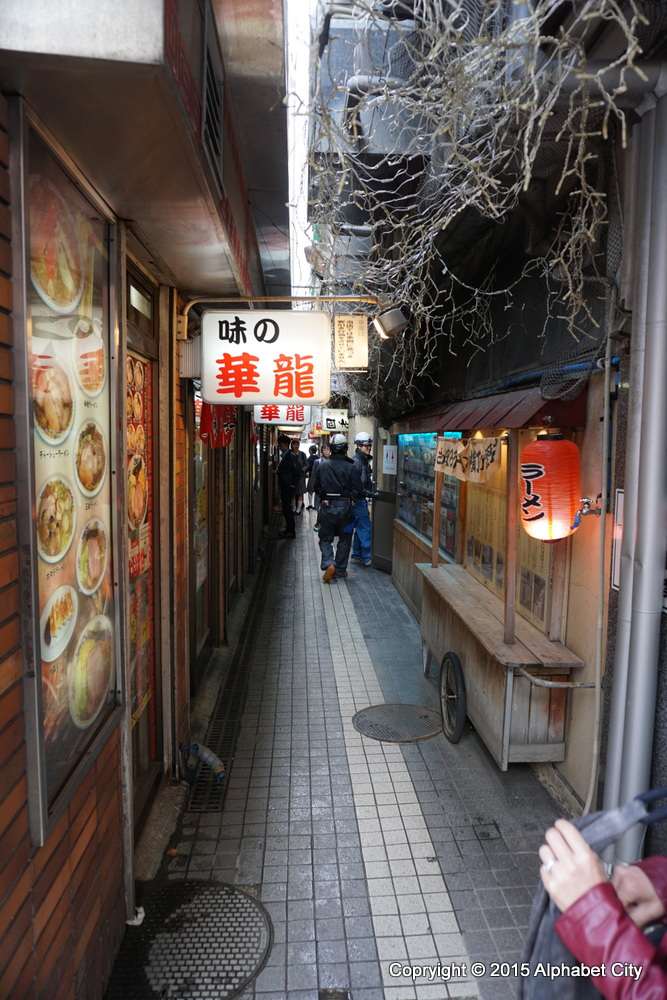
Of course we had to visit my favorite ramen place anywhere:


Yottekoya is getting fancy! Every time we visit, they're a little more upscale. First time, they were a total dive, a literal hole in the wall. (That first pic at the link is their original exterior.) Now they're like a real restaurant.

I've written about this place several times before - I just cannot believe more people don't recognize its greatness. It is just consistently the best ramen I've ever had, and I've had a lot of ramen at this point, in both Tokyo and New York. Yes, it's technically part of a chain, but it's not a chain like we would think of one... each restaurant is completely different, they seem to have nothing in common but the name. The others in Tokyo have never been nearly as good as this one.


I've been to probably 30 or 40 different independent ramen shops now, including many highly rated ones. Many of them are good, and even "bad" ramen is like bad sex - it's still ramen, it can't not be awesome (well, except for Minca in NYC that made my wife physically ill). But none of them have had the melt-in-your-mouth chashu pork or the perfectly balanced broth of Yottekoya. Even their noodles are better than most, and I doubt they're even fresh. Gotta be something in the water out in Odaiba. Seriously, freakin' go here and order the tonkotsu ramen.

You may know this next place - it's one of the most iconic buildings in Odaiba:


That's the Fuji TV building. I didn't realize before that you can go up in that globe:


It's an actual observation deck. Here's part of the view:


It doesn't look very high but because Odaiba really doesn't have many tall buildings and the water's right next to it, you can get a really good view of the main parts of Tokyo.

Of course, you can also visit many of Fuji TV's sets:


(Sorry for cropping my wife there, but she's a little bashful.) That's the set of "Mezamashi TV", Fuji TV's morning show that we had actually been watching all week. It's more colorful in real life than it looks in pictures or on TV. Most sets look cheap and dull in real life, but in Japan, things are often even more amazing in reality.

The Fuji TV building's over on the other side of the island, where the Hotel Nikko, the Grand Pacific Le Daiba and the main tourist areas are (including the Statue of Liberty pictured at top). It's a little more crowded over there, and a lot more expensive to stay in one of those hotels. Not worth it. Take my advice and stay in Ariake.

Sunday, November 29, 2015

Flying Skymark Airlines Sapporo - Tokyo 10/25/2015


Most things in Japan are kind of old hat for me at this point, but flying domestically there ironically still feels exotic. Most tourists (including myself) just fly to their destination and either stay put or take the train to wherever else they're going. This time we flew Skymark back from Sapporo to Tokyo, my first time experiencing a purely domestic Japanese airline. If you've heard of Skymark at all before, you probably know them for this:


That image is actually from Akihabara News, a US-based site specializing in geeky Japanese stuff. But do a Google image search for "Skymark" and their mini-skirted flight attendants are all you're going to see. Skymark knows how to get covered in the US press.

But sorry to disappoint you guys, Skymark actually had these 1960's-inspired uniforms only for a short time and only on their long-haul A330's, which they no longer fly. You can see their regular uniforms (well, with the addition of a straw hat) here. Pretty conservative! This is what they fly around Japan in.

Our flight was really smooth - I shot video of a lot of it:


Sorry about the changing aspect ratio - I shot this with my phone, initially with the flip cover closed (which makes the aspect ratio square) and then with it open.

If you're thinking about flying Skymark, you'll notice that it sounds pretty much like any other flight. They even do the cabin announcements in both Japanese and English, for domestic flights.


I sprang 1,000 yen (about $8) extra for a better seat, which put me in seat 1A at the very front of the plane. Their regular seats have 32" of seat pitch, which is surprisingly comparable to most US legacy airlines, but I'm pretty dang tall so even that's tough for me, and all they had left otherwise were middle seats. The upgrade is so cheap that it's easily worth it, and you even get 300 yen of it back with a free drink.

Overall it was really not a bad experience, and I'm a guy who hates flying domestic back home. But such is the case with a lot of things in Japan vs. the United States. Most things we think of as really unpleasant just aren't outside this country.

If you for some reason need proof of my geek credentials, they were selling model airplanes on board (who still does that here?) and I bought one:


My house is starting to look like a travel agency.

Wednesday, November 25, 2015

24 Hours in Sapporo, Japan 10/24-25/2015

It's taking me forever to write this trip report. Part of it's that I broke my laptop while in Japan (dropped it), and I've been spending a lot of time trying to get a new one I'm happy with. I have bad luck with laptops.

Anyway, our ride on the Cassiopeia terminated in Sapporo. My first time in the north of Japan. It's cold! Tokyo in October is like New York in August, but Sapporo in October is more like New York in December. It was a shock to the system. It even snowed the first snow of the year.

This was one of the few breaks in the weather.

The view from our hotel. Sapporo is surrounded by mountains (similar to Kyoto) but it's not a very picturesque city on its own. No postcard shots.

The reason for coming was actually the overnight train ride, but there were a few things we wanted to do here.

1: Ramen

Every region in Japan is known for its own style of ramen, and Sapporo has a "ramen alley" where about 20 different shops occupy about a half a block worth of space, each with their own take on Hokkaido ramen.

It was hard to pick one, but we eventually just went into the most crowded place, which happened to be the place Anthony Bourdain visited for one of his shows:

Yep, Anthony Bourdain came to the here. 

 When in Sapporo...

The ramen itself. Hokkaido ramen is made with miso and corn, which are specialties of the area themselves. (One of my favorite ramen restaurants in NYC, Misoya, makes this style of ramen.)

It was, as expected, really good, but I think it takes a lot to really impress me with ramen these days. I've eaten at a large enough number of ramen shops now, both inside and outside Japan, that I think I've developed my own specific tastes. I've also just gotten to be a better judge of what's good and what isn't. This was good, but not "wow, I have to come back to Sapporo just to go to this restaurant again" good. I'd certainly be up for trying somewhere else next time.


This is the place, if you're interested.

2. Sapporo Beer Museum


Sapporo's original brewery was, obviously, in Sapporo. I'm not sure if this was really the first one but it is one of them, and it's now a museum. I previously wrote about the Yebisu Beer museum, which is also owned by Sapporo, so this is actually my second Japanese beer museum tour. (Of course, the real attraction is the cheap beer hall at the end.)


The beer hall's nicer than the one at the Yebisu museum, although I think it was slightly more expensive (I seem to remember you could get four beers for 800 yen at the Yebisu museum). The whole building's been pretty lovingly restored, and updated for marketing purposes where appropriate. Those Sapporo star logos are everywhere.

The beer on the right up there - Kaitakushi - is supposed to be the original Sapporo recipe, which you can't get anywhere else anymore. It's been updated over the years for more modern tastes. It definitely tasted less filtered - "dirtier" - than modern Sapporo, but it had more flavor and personality. A little fruity, and a little hoppier. It tasted like a microbrew. I liked it a lot.

3. Soup Curry


Soup curry is not traditional - my wife says it basically didn't exist even when she last lived in the country 15 years ago - but it's become trendy, and Sapporo's known for it.

What is it? It's basically just a much thinner than normal curry served in a bowl like soup.

The place we went is called Suage+, and it had the best reviews of any of the soup curry places we found on TripAdvisor.

I thought it was pretty tasty, but it just reminded me a lot of Thai curry. Japanese curry is normally thick enough to eat with a fork (if you want to), but Thai curry is thin like this and often comes in a soup bowl. The flavor was a little different - smokier, maybe "porkier", whereas Thai curries usually taste like either peppers (red) or lemongrass (green).

That concludes our day in Sapporo! We also did some shopping, but that's not really a blog post. But if it seems like this isn't enough to fill up 24 hours, well, we did do other, more boring things.

Bonus! Hokkaido corn


One thing we really wanted to try was Hokkaido corn - you can apparently buy it grilled on the street in a lot of places in Sapporo. It's really big and sweet. I guess because of the inclement weather, we literally could not find it anywhere. We finally found a few ears pre-packaged like this at the airport, and I bought one. I kept it until we got back to New York - funnily enough, it caused me to get stopped at US Customs!

I didn't grill it (I should have) - I just boiled it. It was definitely sweeter than most corn I've had, but I'm sure this was not the best Hokkaido corn you can get. It definitely felt a little "old" in my mouth, even though the expiration date was still a few weeks away.

Friday, November 13, 2015

Riding the Cassiopeia night train through Japan - 10/23-24/2015


Last month, my wife and I finally fulfilled a bucket list item in probably our last chance to do so - we rode the Cassiopeia train from Tokyo (Ueno) to Sapporo. It took us years to finally get tickets, and we had to pay through the nose for them. Above is the full video chronicle of the trip.


This train is the last scheduled service in Japan to offer a dining car, and it might be the last overnight train making regular runs between cities. (There's a budding "cruise train" industry there, but these trains don't really go anywhere... they just kinda drive around for a while.) Cassiopeia's being discontinued next year once the first part of the Hokkaido Shinkansen opens up, so it was now or never. We bought our tickets through Yahoo! Auctions - and yes, there was a bidding war.


We didn't actually get the "Deluxe Suite with View" pictured here - it's impossible. You can probably see why. This is the only room like this on the train.

And what a beautiful train it is - all shiny and silver and clean, and a perfectly matched set. It hearkens back to the days of streamliners in the United States.

I've been taking long-distance trains all my life in the States - I love it, though I never lived through those glory years. I do have some built-in expectations from that Amtrak experience. In a lot of ways, it was surprising how similar riding Cassiopeia was to riding any of Amtrak's long-haul trains. Of course, like everything else in Japan, in other ways it was a different world.

Cassiopeia's terminal stop in Ueno is really nothing special for what's reputed to be a "luxury" train. There's certainly no red carpet, and the only waiting area is a small set of plastic chairs - it looks like any commuter stop. Immediately I noticed people lining up in a certain spot, but neither I nor my wife knew why, so initially we ignored it while I took video and pics. Too bad!


Turns out the line was for the shower signup, and it was ridiculous. Once the train arrived, an attendant in car #4 started taking names for the public shower. This took forever, I mean I got in it 30 minutes before departure and I was worried we wouldn't even actually make it onto the train before it left. This is the front of the line above - we still hadn't even made it on the train at this point. Of course, by the time we got up there, shower times were all gone. All that waiting for nothing! I had also wanted to take video from our room as we left, but I had to get it while standing in line. This became a theme for the trip.


Here's our room from the outside (this was actually in Sapporo, which is why only this picture looks rainy).


The steps up to our room! We were in car 7, room 22. The train is bilevel, and luckily our room was on top. There's a little spiral staircase that takes you up there. Unlike Amtrak, Cassiopeia's rooms have a combination lock, so you can leave your valuables in there without worrying about it.


And the luxurious interior! This is a Twin, which is the best we could get. These are the standard rooms on the train, made for two people with two extra-wide chairs that convert into beds, and a private bathroom but no shower. I was curious if I'd be able to stand up in our room because the Cassiopeia is no taller than single-level trains, and the answer is no! I had to hunch over to walk around, but in practice it was no big deal because 99% of the time, we were sitting or laying down. The bathroom is in the middle of the car (to the left of this photo) where the roof is highest so I was able to fully stand in there, but walking back and forth was a little bit of a challenge. (The hallway to walk from car to car is at a normal height, so that was no problem.)

Otherwise, the room was extremely comfortable, with plenty of space to stretch out. It was laid out slightly differently but the total amount of space was easily equal to or better than an Amtrak bedroom (not the roomette). Unfortunately some of the space is wasted while you're awake since it's just there to put your feet while sleeping; one person sleeps lengthwise while the other sleeps widthwise, and your heads meet in the middle. But I still had no complaints at all about comfort or space.

My wife's become a big fan of overnight trains since meeting me. She'd never experienced one before (like most Japanese these days, she just took the shinkansen or flew everywhere), but now she loves it as much as I do. So she asked the conductor why they were discontinuing the train when there was obviously so much demand - why not just raise prices? The conductor told her the trains are actually getting old, and a lot of things are breaking down. Of course, by Amtrak standards the Cassiopeia is practically brand new, but this is Japan - 16 years old is ancient, and honestly Japanese trains aren't built to last. So it made some sense to think that maintenance might not only be a rising cost but also a problem in keeping the trains running at all. There are only four sets, so they all need to be in running condition to make the schedule.


After our conductor checked our tickets, we headed to the lounge car, which is a real observation lounge in the style of something like the old Milwaukee Road Skytop Lounges. At this point of the trip it was actually hooked to the front of the train, but interestingly enough the Cassiopeia makes several directional changes along the way, giving both passengers in the lounge and in the Deluxe Suite at the other end of the train a chance to have an unobstructed view for part of the trip. There are three engine changes, and each time they just hook the new engine to the other end of the train.

We knew already that we would need to wait to eat in the dining car until after the main dinner seating. You basically have to make a reservation when you buy tickets, and we couldn't do it while outside Japan, so they were sold out by the time we landed at Narita. After the regular dinner service they have 45 minutes of "pub time" where you can get simpler meals without a reservation. We asked our car attendant if it's necessary to line up and he recommended we do so 15 minutes ahead of time. We tripled that and got there at 9PM - and we were glad we did, because we managed to get a table for two, while not everybody behind us got in at all.


I was totally happy with my meal (beef stew with rice) while my wife only had an order of sausages because she'd already eaten some "ekiben" just in case we didn't make it in. It was really nice having a table for two in a dining car - this is not something Amtrak offers. (On the other hand, there's virtually no chance of not being able to even sit in an Amtrak dining car.) There's no way to really have a romantic meal in the dining car on an Amtrak train - every meal is a social event, with strangers at your table.

After dinner, we made our beds and tried to sleep. I have a hard time sleeping on trains because of the "surprise" bumps that inevitably happen - any time we hit a particularly strong bump or lurch to the side, I wake up. Also any time we stop. Or go slow. Pretty much anything outside of normal smooth running at high speed will wake me up. So I was in and out of consciousness all night, despite what felt like a long stretch where we were going about 10mph. I found out the next morning that they had padded the schedule with an extra two hours vs. the online schedule I found for this train - so I guess they expected it, but I thought we were late for most of the morning.

Overnight, the train goes through the Seikan Tunnel, the longest undersea tunnel in the world, and the deepest. I heard and felt it, but was dozing at the time so I didn't pay much attention. I was a little afraid of waking up, because honestly being under the actual ocean kind of freaks me out.


We lined up for breakfast in the dining car 30 minutes before it opened, and we still weren't at the head of it. Luckily we managed again to get a table for two, and breakfast was actually really tasty and filling. There's just something about eating while watching the scenery go by...

After breakfast, we hit the lounge car again one last time, both for the experience and to see the new power we'd acquired overnight. This train starts with a purpose-built EF510 electric from Ueno (usually in Cassiopeia colors, though ours was in the blue Hokutosei scheme), then an ED79 diesel-electric overnight, then a couple of DD51 diesels for the non-electrified rural sections of Hokkaido. The lounge car was fun but there was something weirdly stressful about it - it always feels like there's somebody waiting for the seats in front of the windows, and there's no real reason to be in any other seat vs. your own room. The windows are no larger.

As on Amtrak, we were actually mostly happy with being a little later than we'd originally planned. It gave us a couple of hours to simply relax in our room, which we hadn't really been able to do before. I felt quite busy on this train. It's a pretty short trip for a long haul train - about 16 hours, much of which is overnight. So with all the waiting in line and then meals, shooting video and photos in the lounge car, etc. we didn't have a lot of time to just sit and watch the scenery. And Hokkaido is when you finally get out into nature.


We arrived at Sapporo "on time" (2 hours later than the original schedule) and stayed to take some photos and watch the train leave. My wife told me she even got a little melancholy watching the train pull away, knowing it would be gone for good in just a few more months, an entire era of Japanese train travel gone with it.


Japan is a small country, and this is about as long a journey as it can have. For the Japanese, 16 hours on a train must feel like forever. For someone who's taken Amtrak across the entire USA, though, I actually felt a bit rushed on the Cassiopeia. One of my favorite things about long haul trains in the USA is the feeling of having nothing to do - being able to sit in the lounge or your own room and read for hours, getting out at fuel stops to stretch your legs for a while, and seeing the vast stretches of the United States that are empty, punctuated only by natural wonders and the animal inhabitants that call it all home. There's a feeling of quiet and serenity that you get on an American train that was missing on the Cassiopeia.

But that's not the train's fault, it's just the nature of the country. There's a lot to do and not much to see after leaving Ueno until you get to Hokkaido the next morning, and by then you're almost at your destination. It's a little funny complaining that 16 hours is not long enough to really appreciate a train like this, but it's true. (I wonder if people said the same about the 20th Century Limited back in the day.)

A little writeup on our day in Sapporo is next up!

About This Blog

This is increasingly not a blog about Alphabet City, New York. I used to live in the East Village and work on Avenue B, but I no longer do. Why don't I change the name if I'm writing about Japan and video games and guitars? Because New Yorkers are well-rounded people with varied interests, and mine have gone increasingly off the rails over the years. And I don't feel like changing the name. I do still write about New York City sometimes.

Followers

  © Blogger templates The Professional Template by Ourblogtemplates.com 2008

Back to TOP