The US may have a virtual monopoly on the post-apocalyptic genre, which often stands in as an allegory for real-world fears - fears of loneliness, sudden poverty, and lost hope.
Japan has its own dark "genre" - really more of a movement - and it's a lot more direct. These films are all about the lurid underbelly of modern Japanese society - subjects that everybody knows but nobody talks about. Things like bullying, rape, suicide, prostitution and murder.
Japan has a long history of dark family melodramas, which explored the strained dynamics of families during wartime or under new western influences. But these modern films have some unique traits - they're more often about loners or young people, to start. Oddly enough, the first unifying trait I noticed in these films was that many of them star the same actors, almost like there's a specific troupe making them. You'll be seeing a lot of Rinko Kikuchi, Ayumi Ito and Yu Aoi if you watch all of these!
My wife and I have searched for whether there's a universally accepted term for this movement yet, and the closest we've found is "utsu eiga", which loosely translates as "depressing movies". (But yes, people in Japan talk about these films as a distinct movement too.)
You might ask "why?" Why does happy, goofy Japan - land of life-size Gundams and J-pop and robotic butts - make movies that are really dark and sad? Well, in Japan there is a saying that "the tallest blade of grass gets cut down". Conform, or else. These movies are about the tallest blades of grass.
My wife and I have watched a bunch of these (and I've even written about a few before), and many of them are beautiful, unique and inventive. They tell dark but universal stories from a distinctly Japanese point of view - not completely unfamiliar, but you might see some things in a new way.
They're also very slow, but the best are hypnotic. Don't let the pacing scare you - just go with it, and eventually you'll feel like you're riding a raft down a calm river - one with a giant waterfall at the end of it.
Without further ado, here's a list of some utsu eiga that are worth checking out - all of these are available on DVD or Blu-Ray in the US (and some on Netflix streaming):
1. All About Lily Chou-Chou
A high school student runs an online fan forum dedicated to an ethereal pop singer. Her music lets him temporarily escape his reality of bullying and petty crime. It's almost impossible to say more without giving away spoilers, since the entire film is one slow and depressing surprise after another, culminating in a fateful concert that provides a cathartic yet ambiguous ending. A word of warning: several scenes will make you really uncomfortable, assuming you're a normal human being. But the film's also ethereal and beautiful, like the songs of Lily Chou-Chou herself. I thought about this one for days after seeing it; it's probably the deepest, most complex film here.
2. Suicide Club/Noriko's Dinner Table
You know a film that begins with the simultaneous suicide of 54 schoolgirls in front of a rush hour train is going to be dark. That sets off a chain of copycat suicides nationwide, with a pop group seemingly somehow behind it. Suicide Club focuses on the police investigation into what's causing these suicides, while Noriko's Dinner Table, its companion film, goes deeper into the psyche of the individuals involved in the supposed "club". The latter film isn't a true sequel or prequel but takes place before, during and after the events of Suicide Club (in Japan, it's known as "Suicide Club 0").
3. Adrift in Tokyo
An aimless and indebted college student meets up with a loan shark who promises to wipe out his debts if he just accompanies him on a walk across Tokyo. Not knowing why but having no real choice in the matter, he agrees. They walk. Secrets are revealed. A fateful decision is made. A kind of forced but real friendship develops. This is a dark buddy movie.
4. Norwegian Wood
I'm cheating a little with this one since it's written and directed by a French Vietnamese, but it's adapted from a Japanese novel, stars Japanese actors and was released first in Japan. Some have criticized the film for cutting a lot of the 1960's radical politics out of the plot and instead focusing on the love story, but it is a tragic love story that's filled with death and loss. (It's actually kind of a "bizarre love quadrangle".) The film still touches on many different issues, including how Japan deals with mental illness (hint: not well).
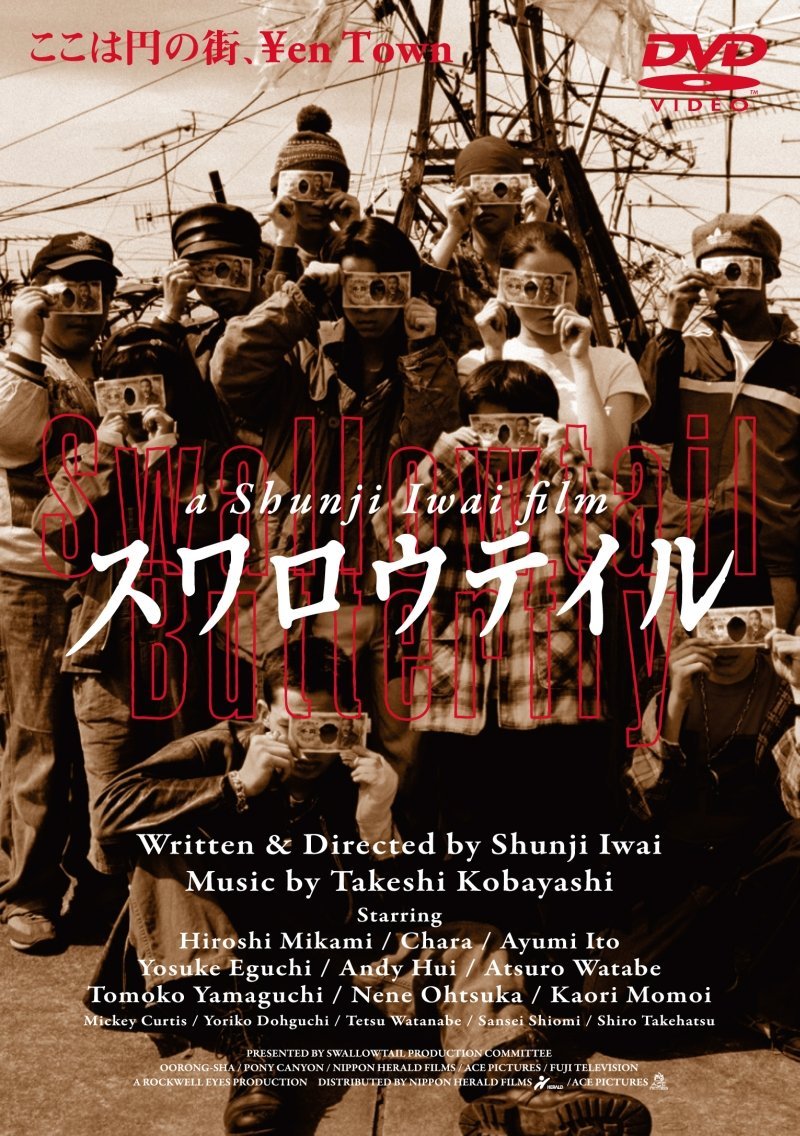
5. Swallowtail Butterfly
Written and directed by the same guy behind All About Lily Chou-Chou (Shunji Iwai), Swallowtail Butterfly is about the closest Japan generally comes to a serious post-apocalyptic film. Set in an unspecified dystopian future, Japan now has a large and growing underclass, fueled by unemployed immigrants from China and elsewhere who speak a mixture of Japanese, Chinese and English. These immigrants have formed their own shantytowns, one of which is called "Yen Town" because they'll make money any way they can, including theft, prostitution, and any scam they can think up. When the citizens of Yen Town decide to go legit, though, they find it's not that easy.
6. Nobody Knows
Four siblings are left at home alone by their mother for weeks at a time, and eventually forever. They learn to fend for themselves, scraping by through begging and eventually other means. But when the oldest and most responsible sibling begins to drift away from the rest, things really take a turn. You'll think it can't get any worse for them, but it does. You'll also think "no way this could happen in Japan"... but this is the only true story on this list.
7. Battle Royale
Lots of people have compared this to the Hunger Games, but they are very different movies. Battle Royale is an allegory for high school itself, with adults in the film forcing students to literally kill each other. The implication is that adults not only turn a blind eye to high school bullying, but are in fact complicit in it. The survivors don't make it out because of the system, but in spite of it.
This is a film by Takeshi Kitano, who could actually appear several times on this list. His films often explore themes of alienation and tell stories of societal outcasts. But, well, this is probably his most famous in the west, so it's my pick here. (Also, I couldn't remember the names of any of the others I've seen!)
8. The Taste of Tea
Admittedly it's been a while since I watched this one and I don't remember it too well. But I do know that it's probably the closest film on this list to one of Japan's earlier family melodramas, in the vein of Tokyo Story or other Ozu films. Each member of the Haruno clan has his or her own eccentricities, and they're all celebrated here in a series of vignettes that adds up to a film that seems to say "we're all weirdos - deal with it."
This is technically a comedy, though I remember it as a drama and Amazon's quotes from Trinie Dalton note that it revels in "odd, awkward moments of reflection or confusion." My memory is that it's like a much slower Wes Anderson film.
9. Linda Linda Linda
I hesitated to include this on the list because in the end it is an uplifting film, but it still has many of the hallmarks of an utsu eiga. A group of high school girls forms a punk cover band, and when their singer quits, she's replaced with a Korean exchange student who barely speaks Japanese. Among the themes in the film is the difficulty foreigners have fitting in to Japanese society, especially teenagers who might not be emotionally equipped to handle it. So it's got a lot in common with some of the other entries here.
Incidentally, western directors have tried to make their own utsu eiga, set in Japan with Japanese actors, but with the exception noted above, these have generally not been very good.
This is by no means an exhaustive list - just some of the films I've seen. I'd love to hear your recommendations!
I'm not sure if you guys have heard about this, but there's a new Star Wars movie out.
I don't usually talk about big Hollywood blockbusters on my blog, because what am I going to add? Go read Rottentomatoes or something. But this is different. I grew up with the original trilogy, and after the disappointing prequels, I was still left aching for a new movie that really "felt" like Star Wars. This is personal for me.
So first things first: The Force Awakens is AWESOME. It's everything I want in a Star Wars movie, and probably more.
I've noticed not everybody shares this opinion, though, and that's just unacceptable. I'm not sure, but it seems to me that there's something of a generational split here. So let me list the reasons why this is a great Star Wars film.
Spoilers ahead, obviously.
1. Rey. Hey, did you know Luke Skywalker was originally supposed to be a girl? Anyone who's bitching about Rey being female (really? in 2015?) needs to shut up. And I don't know where they've been hiding Daisy Ridley - so much charisma, and just the right balance of strength and femininity. If the entire story arc of these films ends up being mainly about her, I'm completely on board. (Yeah I like Finn, but this feels like her story.)
Oh, also, she's definitely Luke's daughter.
2. Kylo Ren. Such a contrast to Darth Vader's perfected Sith-ness, Kylo Ren is an imperfect, developing villain - a wannabe gangster who's prone to temper tantrums and has limited command of the Force. Even his saber-building skills seem questionable - only his own saber glows with that "dirty" light that looks more like fire, which suggests that he just doesn't really know how to build them right. This is all a lot more interesting at this stage of the game than if he was an unbeatable Vader-like badass.
Some people have complained that he's basically Annakin II, but the big difference here is Hayden Christensen vs. Adam Driver. Also, Annakin's character was a whiny little weasel-man who was nevertheless really good at being a Jedi/Sith. Kylo Ren talks a good game and looks the part, but he is currently very bad at his job. They're complete opposites, in fact. (But, you know, Vader is his grandfather, so... a little similarity is pretty understandable.)
3. The OG cast. I admit, I teared up a bit when I saw Han and Leia together again. And somehow, Harrison Ford looks younger than he did in Indiana Jones and the Crystal Skull. He slipped right back into the role of Han Solo - older, hopefully wiser, but still snippy, wisecracking and swashbuckling when he needs to be. And while his fate made me sad, this was still basically Han Solo's movie - and that was an unexpected treat. Meanwhile, Carrie Fisher didn't do a whole lot but her presence is pure fanservice, and there's nothing wrong with that. Mark Hamill had very little screen time (and no lines!) but man, he made the most of what he got. What a moment for him!
4. The First Order. What a bunch of incompetent fools! And that's great. This is not the Empire - this is a cult of terrorists trying to copy what they know of the Empire, and getting a lot of it wrong. It's a parallel to ISIS, Al Qaeda or other real-life terrorist cults. Lucky for them, the New Republic has demilitarized since the fall of the Empire, so it's not strong enough to crush the First Order outright. But both sides are having to re-learn everything about war - and that makes total sense at this point in the overall story.
I've seen plenty of people elsewhere online who just do not get this. They think the First Order is the Empire by another name, they don't understand why they seem like such idiots (including Kylo Ren). But not only would that be uninteresting (we've, uh, seen the Empire before, guys), it also just wouldn't be any fun if the bad guys were an impenetrable wall of death for the protagonists, who themselves were just minding their own business before stumbling into the story. None of these people are well trained, and half the fun of the movie is seeing them try their best to fight.
This is also why I have no problem with what amounts to a third Death Star. The entire point is that the First Order is (clumsily) trying to do exactly what the Empire did!
5. Mysteries are back! One of the great things about the original trilogy was that it didn't explain everything. What were the Clone Wars? How did Annakin get turned to the dark side? What is the Force, anyway? Nobody ever really explained these things, and they didn't need to - that let us have something to chew on after the movie ended. In The Force Awakens, 30+ years have passed and we only get glimpses (both literal and figurative) of things that happened in that time. We're left with a lot of questions - what actually happened between Kylo Ren and Luke? How did Han and Leia split up? Where does the First Order get its money?? Some of the backstory will no doubt be fleshed out in the next films, but some probably won't - and that's totally okay.
6. Emotion is back! The original trilogy were highly emotional films - Obi-Wan's death, Darth Vader's big reveal to Luke, the final removal of his mask, etc. All of that was gone in the prequels, which had scripts that felt like a checklist (but tried really hard to force some emotion right at the end, long after we'd stopped caring). But there were at least three points in The Force Awakens that got me choked up, and all throughout I really cared about these characters because they all seem so human. I also thought the ending was the most emotional moment of the entire series so far. Even the saber battles finally felt meaningful again - and it's that meaning that gives them weight, not how flashy or fast they are.
7. A sense of perspective. The prequels tried really hard to be sweeping epics, with a huge cast and a ton of stuff going on in every frame. But The Force Awakens has downsized the series to what it once was - the story of a few iconic characters with a ragtag fleet just trying not to get blown up. At the start of the movie, the entire "Resistance" fleet seems to consist of about 30 X-Wing fighters, plus (eventually) the Millennium Falcon. Meanwhile, the First Order controls just one planet, and while their presence does strike fear at least within their own star system, it's not because of sheer numbers but because they have a habit of torching entire towns as soon as they arrive.
And remember how in the original Star Wars, the Empire sent just four TIE Fighters against Luke and the Millenium Falcon, despite he and the stolen Death Star plans being the most important things in the universe to them? Plenty of moments like that in TFA too. You don't get the sense that anyone has unlimited resources like you did in the prequels. And it's a lot easier to care about what's going on, because every person and even every piece of equipment you see is important.
8. Real sets, characters and props. Go ahead and watch the prequels again - they look and feel like cartoons. Nothing looks real. And hardly anything was - even basic sets were almost all CGI, with much of each movie shot against full green screen. But in The Force Awakens, while there's still plenty of CGI, stuff that "should" be real is real. If an X-Wing is sitting on the ground in a shot, there is an X-Wing sitting on the ground on the set. When Kylo Ren drops his helmet, it clangs on the ground, because it's made of thick metal and it's heavy! The whole movie feels real as a result.
9. Acknowledgment of the fans. George Lucas eventually got to a point where he seemed to enjoy torturing long-time fans of the series - he hated the people that made him a multi-millionaire. The prequels were basically a giant "fuck you" to all of us, and even the original trilogy was made worse over the years in the name of Lucas' own vanity.
But JJ Abrams is one of those fans, and he's given us basically exactly what we've been asking for all these years. This series is fun again. It feels like it was made for an actual audience, not for Lucas' own personal collection as a joyless, soulless old man.
I did feel like the pacing was a little inconsistent at times - the final shot was pretty damn impactful but the ending scene itself felt tacked on until that very last moment. Events prior to it should maybe have not dragged on so long (which made that feel like the ending, and the actual ending an epilogue). In general, it is a long movie and it probably could have been tightened up in several scenes.
But goddamn, I still want to see it again. And I'm excited for whatever's coming next.
Like most people, I first became aware of Naomi Watts in MULHOLLAND DRIVE, which is one of my favorite movies of all time. (I'm a David Lynch fan.) Since then, there's almost nothing she's done that I haven't been intensely interested in. She just does not give a fuck. She can and will do anything. ANYTHING. That's a big part of what makes her fun to watch.
This is a chopped up scene from THE IMPOSSIBLE, her 2012 film about the 2004 Asian tsunami, which my wife and I watched the other night:
That's real water. In the special features, the kid playing Lucas says a lot of the fear in their faces wasn't acting. Later in the film you see that Naomi Watts is actually shoved through that glass wall by the wave. Not a stuntwoman! (Sure, it's breakaway glass, but still - you try getting hit by a wall of water through a solid object!)
THE IMPOSSIBLE is a pretty good film, although I was a little uncomfortable at times with the story of that tsunami - which largely killed poor Southeast Asians - being told from the point of view of rich white tourists. I guess that makes it more "relatable" to us westerners. Still, Naomi Watts does her goddamn best to make us understand how awful it was whatever your ethnic background. (By the way, I liked Ewan McGregor in the film too, but this post is not about him.)
A lot of actresses are afraid to even get dirty. It's going to spoil their precious image and ruin the illusion that they're beautiful. Not Naomi Watts:
It's even more amazing that she's doing this at age 44! (Even she says on the special features, "I'm not 25, but I'm being thrown around like this.") She's aging amazingly well - admittedly, kind of hard to tell in this shot. But she's still hot!
This is the ultimate realization of her natural state on film. If you put Naomi Watts in a film and she doesn't end up at least with matted hair and preferably covered in blood, mud, dirt, smeared makeup, tears, or a combination of all of those by the end, you're doing it wrong. You have not challenged Naomi Watts. She's bored! She's been building up to this.
MULHOLLAND DRIVE:
21 GRAMS:
THE RING TWO (sorry, couldn't find a good shot from the first one):
KING KONG:
I don't know how this woman has not won ALL the Oscars. I mean, anyone who can make KING KONG watchable... come on. She's everything an actress should be. And not just because she likes to get down and dirty.
This is the face of a woman on a mission:
Intense. Naomi Watts will hire Jacob from LOST to kill you if you don't give her all the Oscars. The dichotomy about her is that this thin little blonde woman with a chipmunk face can be such a badass. And that intensity is the reason.
She didn't have to be this type of actress - she's always had the looks to play glamour roles:
And she's not above appearing in sexy magazine layouts. Which only makes me respect her more. She chooses to take on roles like MULHOLLAND DRIVE, 21 GRAMS and THE IMPOSSIBLE. She doesn't have to. She could take her pick of lightweight Hollywood rom-coms and period princess dramas that don't require her to get grimy, sob believably on command, scream at the top of her lungs or come close to drowning. (And sometimes she does, when she just wants a few days at the beach. Hey, she's earned it.)
I've been neglecting this blog again - really just been too busy. I'll post an update soon, and then hopefully get back on a more regular schedule now that things are settling down a little bit.
But what brings me back right now is this special little movie that I just can't turn away from whenever it's on - and that I just finished again for about the tenth time. It didn't get a lot of press when it was released (I didn't even know about it), but it deserves an audience.
I'm sure there's something about Caden, the main character, that I see in myself. That's often true of movies like this, about conflicted male characters who seem trapped in a world beyond their understanding, and which doesn't understand them. The Kafka-esque health issues hit pretty close to home too, and the theme that "the end is built into the beginning" is something I'd begun to think about even before seeing this film, as I start to come close to middle age. We all make choices every day, and every choice we make affects our lives not just today, but forever - and the end result of those choices is inevitable.
I'm not sure this film's for everyone, but it spoke to me. Please give it a try and rent it.
I'm sitting in the parking lot of Spa Resort Hawaiians in Iwaki City, Japan. Why sit in the parking lot writing a blog post while the rest of my wife's family enjoys themselves inside? Well, let's just say the place is climate controlled. For tropical weather. It's the kind of place where street clothes are actively discouraged, and unfortunately, I wasn't ready to get my bathing suit on. I'll spare you the photos of the sweat stains and the goofy American guy walking around in Doc Martens while the rest of the place goes barefoot. (Honestly, though, I wasn't the only guy there who was overdressed.)
So why the hell did I come here in the first place?
For the Hula Girls!
One of the goofy Japanese chick flicks my wife coerced me into watching was about this place. As usual, I think I ended up liking it better than her, even though it's totally manipulative and sappy. Still, it really was a true story - pretty much all of it, apparently - and that makes it a little easier to take at face value.
This used to be an isolated coal mining town, until the coal ran out and the mining company moved away. The government's bright idea to save the town was to build an indoor theme park modeled on Hawaii. The showpiece would be a hula dance troupe made up of girls from around the towns of Joban and Yumoto. Given that nobody in this conservative little area had any experience doing anything except mining coal, a lot of people obviously thought this was a crazy idea. But, well, it wouldn't be a very good movie if it ended there, right?
So a cosmopolitan but otherwise washed-up dance teacher arrives from Tokyo, at first much too diva-ish for this little town full of men and women who still think showing a little ankle is taboo. But eventually her group of spunky wannabe dancers wins her over, and with her help they convert the rest of the town into believers. And waddaya know, it works. The Joban Hawaiian Center (as it was called back then, and is still colloquially called now) saves the town, with the Hula Girls drawing massive crowds.
More than 40 years later, they still do.
Here's the kinda lame trailer to the movie:
I'm not sure if the girls are all still from around town. They don't really look it - they look Polynesian, although some of that's obviously just makeup and hair style. But they're clearly professionals now - I mean, this has been a famous dance troupe for decades at this point.
There are two big dance shows per day, plus a few smaller ones sprinkled throughout (there's one just for kids). We went to the early show, which probably isn't quite as elaborate as the later one, but it was just too hot to even consider staying. I mean I know I talked about it already, but walking in there from outside is like a slap in the face every time. It's like hitting a wall of humidity. Honestly, I've been to Hawaii, and Hawaii is not like this. I wasn't sure I'd even make it through the show. I had to prepare - we bought a Chinese-style fan ($16), a towel ($5), and a bottle of water ($1.50) before I could sit in any semblance of comfort. My wife wasn't quite so bad - I did fan her a bit too, but it's like this in late summer everywhere in Japan, so she's kind of used to it.
It was worth it, though. Hula is one of those dances that's hard to really get until you see it live (though the movie version's pretty good too). It is amazing how those girls move. It is a sexy dance. And actually really graceful too; it's not all booty-shaking like you usually see on TV, though there was plenty of that in the finale. It's kind of like a combination of ballet and pole dancing.
I have to mention the fire guys too, who may well have been in the movie for all I know, but I don't remember. But they were amazing, doing the whole fire baton twirling thing, really really fast, without making any mistakes whatsoever. Totally perfect, all three of them, and each also doing crazy stuff like licking the fire, or grabbing the fire on one end of the baton and setting fire to the other end with their bare hands.
If you do actually come better prepared than we did, there's a lot of other stuff to do at this place - water slides, wave pools, etc. There's also a real spa, as the name suggests, an arcade, various restaurants, and a hula museum, most of which is more specific to the Hawaiian Center than hula in general. They've got a big exhibit on the movie too - these are some of the real costumes the characters wore:
Oh, one thing - the movie apparently wasn't filmed here, but it looks really similar. They've changed the configuration since the 1960's anyway, and the photos in the museum from that era look almost exactly like the movie. It's uncanny. Watching the show really felt like being in the movie, even with the stage facing the opposite way. I highly recommend the movie, and I even more highly recommend seeing the show live if you can.
If you do go, you really need to stop at Papa bakery on the way out. Japanese bread is a whole post unto itself (hmmmmm...) and this is some of the best I've ever had.
That's a melon pan, a curry pan, a cream puff, and some other stuff for the family. Really, really yummy.
One of the caveats of being married to a Japanese woman is that I'm coerced into watching Japanese chick flicks every once in a while. But the weird thing is I usually end up liking them better than my wife does. I don't know what that means.
This weekend, we finally watched "Nana", the 2005 film adaptation of the massively popular shoujo manga. My wife is a HUGE fan of the manga, and she was really excited about the film adaptation when it first hit theaters. Living in the US, she never got to see it, so she was excited again when it was finally released on DVD here about six months ago. We finally Netflixed it, though it took about a month of convincing before I actually sat down and watched it with her. But after my Dark Knight and Hancock and Iron Man, I kinda felt obligated. I think she's regretting all that effort now.
This is a story about two girls that are both named Nana who meet by chance on a train to Tokyo. They are opposites - one is a jaded, aspiring rock chick and the other is a cute, somewhat dim-witted but otherwise typical suburbanite. By chance again, they end up roommates, then friends. Each ends up helping the other through some difficult times. Yep, your standard chick buddy flick. It's actually pretty much the same plot as "Kamikaze Girls", which I've mentioned here before, just with a different backstory.
The trailer (press the "HQ" button!):
Probably unlike the manga, the main plot of the film actually revolves around Nana Osaki, the rock chick, who's easily the more interesting and three-dimensional of the two anyway. Through a series of flashbacks we learn that she was involved with Ren, the bassist from her old rock band, who left to join another, more mainstream band named Trapnest that just happens to be Nana Komatsu's favorite. (In the process, he switches to lead guitar.) Just as Nana O is putting her life and her own band back together, Nana K wins two front row tickets to see Trapnest in concert, inviting Nana O to go with her. Well, you can guess the rest. Meanwhile, both girls basically fall in love with each other, though not in a romantic way, but in that weird almost romantic kind of way that girls sometimes do and that guys can't ever really get their heads around. We're talking overtones.
Nana K's own story ends up being basically an out of place subplot in the film - her jerk of a boyfriend is cheating on her, blah blah blah. Sad. (There was way more to it in the manga, but it's been cut down in the film.) Nana K's story serves mostly to advance the relationship between the two girls, whereas that relationship then advances Nana O's story with Ren.
The whole thing is heavy on the schmaltz and there's lots of crying. But you know what? Japanese filmmakers are really, really good at this kind of thing. The art of melodrama is lost in this country - we've turned it into such a formula that all the real emotion just gets sucked right out of it. Japanese melodramas - at least the best ones - pour it on just as thick as American melodramas but somehow manage to suck you in anyway. They're so well-calculated that even though you're completely aware of being manipulated, you still get caught up in it. There are scenes in this film that I know I should want to laugh at for excessive corniness, but instead find myself actually getting a little choked up.
Authenticity is the key, especially with Nana O. Mika Nakashima was an inspired bit of casting in that role - she was already one of Japan's top singers, so there's nothing about her that doesn't feel real. She is real. And she looks and acts the part, down to the Vivienne Westwood clothing and accessories, though she's not quite as matronly as the manga and anime version of the same character. (I think I like the film version better; a little more realistic for a 20 year old.) Ai Yazawa, who wrote the original story, must have had some experience in a band. All the details are right, including just how normal most of the time you spend with your band is (one of Nana's bandmates seems to be a big melon cream soda fan). American films never manage that - there's too much stereotyping and glamorizing. And that makes the emotions feel fake too.
It helps that the most emotional scene of the film is set at a rock concert. The film has two of these leading up to the finale (one of Nana O's band, one of her ex-beau Ren's Trapnest), and both of them feel totally real even though they clearly aren't - the music is pre-recorded. I suspect they were, in fact, filmed in such a way as to maximize sell-through of soundtrack CD's. They still look and sound convincing, though, and the atmosphere is exactly right. Everybody's playing the right notes and strumming on rhythm and whatnot; it doesn't feel faked. And this is a setting that, in real life, really can bring out all sorts of raw emotions.
My wife disliked the film. It actually made her depressed for the rest of the evening.
For her, it just cut too much out of the manga. That might be true; it only has three out of five stars on Amazon Japan (vs. four and a half on Amazon USA). She also called Nana K "annoying" and said the plot was "unrealistic". I'll give her that Aoi Miyazaki, playing Nana K, was a bit much - and it's a little ironic that she's the one that got more popular off this movie. (As my wife said, "Japanese guys like innocent girls.") I was obviously a lot more taken with Nana O (and not just because she looks and acts exactly like a former roommate of mine!) I guess this movie actually appeals more to American tastes than Japanese.
But I think it appealed to me not just for the reasons listed above but also because it actually made me nostalgic - a big part of the film is actually about the ups and downs of being a performing musician. The thrill of being on stage, yeah, but also the depressing, down periods when you're not. Performing live is like an addictive drug; once you've experienced it, all you want to do is experience it again, over and over. That's how bands can go on grueling, year-long tours again and again throughout their careers. And when you're not on stage, it's just a dark, lonely existence. Yeah, you can tell I miss it. I am Nana O!
It is just a sweet film too.
Of course, a lot of the feminist stuff is a bit lost on me, and that was the main point of the manga (and anime). It's intended to be a story of two girls learning to live lives that are independent of men, relying on each other instead. I think the film is honestly missing some of that anyway, or at least it doesn't beat you over the head with it like the manga and anime do. Maybe that's one reason why its rating in Japan is lower than here; the message is a bit lost. It's a message that probably feels really important in Japan right now, where women and girls are searching for empowerment in a country that's years behind us in feminist terms.
The film was a lot like the manga in at least one way:
It's very close, visually.
There's a sequel (imaginatively called "Nana 2") that again stars Mika Nakashima as Nana O but replaces Aoi Miyazaki as Nana K (she declined to appear - got too popular, had better things to do). The sequel is good too, but it's very sad throughout and pretty bleak at the end. Unlike the first film, it feels in need of another sequel to tie up loose ends, and there probably won't be one coming. It's also got some obviously-cheaper production values - at least 50% of it takes place at the girls' apartment. On the plus side, I think the casting of the second film is actually a net gain. Many of the actors have changed, but most for the better - including Ren and Nana Komatsu, now played by Yui Ichikawa. She's a lot less annoying than Aoi Miyazaki, and no less cute.
And of course, there's an anime, with a theme song by Anna Tsuchiya. I'm watching through this now and it is much more faithful to the manga - in ways both good and bad. So far, the film is better - I'm not a huge fan of unnecessary exposition. The film really boils it down, separates the wheat from the chaff. Unfortunately, there is no US distribution for the anime yet, but search around and you can find it.
I think I avoided seeing "The Dead Pool" because of its pretty horrendous reviews - and it's clearly the worst of the Dirty Harry movies. But still, it's Clint Eastwood! As Dirty Harry! So I finally watched it on TBS or something last night.
Mostly it's a bone-stock thriller, and both Eastwood and Harry had obviously mellowed a little in the decade or so since the first film. But it's got the best car chase ever - it's even better if you don't know the context:
Bonus props to this movie for starring Evan Kim from Kentucky Fried Movie's "A Fistful of Yen" segment as Harry's partner. Talk about a weirdly coincidental Clint Eastwood connection.
Another one of my double features, this one an example of the modern wave of Japanese splatter films that's been getting more and more attention over here.
These films both generated controversy and strong (mostly positive) reactions at western film festivals, due to both their subject matter and their level of gore. They've gained a little bit of cult status since their release earlier this decade, similar to "Battle Royale", another film I'd put in this genre and probably the "Pulp Fiction" of Japanese cinema in terms of its influence.
Both films have suicide as their central theme. "Suicide Club" (aka "Suicide Circle") came first, and tells the story of a wave of youth suicides plaguing Tokyo, including a group of 54 schoolgirls who jump in front of a train (in graphic fashion) and another group of students who casually jump from the roof of their high school. The mystery is what's behind the suicides, and most of the film is told from the point of view of the investigators - C.S.I. style.
"Noriko's Dinner Table" is billed as a "prequel", but it's really more of a parallel story. "Suicide Circle" leaves a lot of questions unanswered, and "Noriko's Dinner Table" does not answer many of them. Instead, it's a story of the alienation behind the suicides from more of a personal level, focusing on three specific girls who may or may not be part of the "suicide circle" - if such a thing even really exists in the fictional Tokyo created by director Shion Sono.
I watched both of these films with no pre-judgments - I had never heard of them. My wife wanted to see them, but I went in cold, not knowing either their reputations or their plots. Since then, I've read quite a bit about them, and some of the reactions by westerners I consider very strange.
First, these types of films are not particularly popular in Japan. They are neither reflective of society nor embraced by it. Many westerners seem to want to interpret them through the prism of Japanese societal stereotypes, but I think that misses the point. No, most kids in Japan are not constantly contemplating suicide. Most are not even particularly unhappy. Most parents are good parents, most kids are good students, and they mostly stay at home and do their schoolwork, go to college and get jobs. Japan is a really, really normal country, despite the weirdness and darkness that westerners seem to like to project onto it. In fact, I think it's just as likely that these films are a reaction to the boredom that comes from living in such a normal, peaceful place as the reverse. It's similar to the random and unfocused angst a lot of American kids feel living in the suburbs.
Second, from a pure filmmaking standpoint, these films are just not very well-crafted. The same is true of "Battle Royale" and most other Japanese films in this genre. They suffer from a lack of control over the script and dialogue, overly long exposition (endless, ENDLESS scenes of characters explaining their feelings in voice-overs), a lack of coherence, poor editing, uninteresting cinematography, and other problems. Occasionally they're bad enough to be laugh out loud funny, unintentionally. They're also just plain too long.
(I am a huge fan of guys like David Lynch, so it's not that I have a problem with needing to think, or with long films. What I have a problem with is utter randomness in a narrative film.)
In fact, I've noticed that a lot of Japanese films are revered here in a way that I don't think makes a lot of sense. I think some people might confuse a good concept with good execution. Maybe Americans are just so hungry for something unique that they're willing to overlook obvious (and repeated) flaws, or chalk them up as "cultural differences".
You're right to then wonder why I give them this much attention. Partly it is to say exactly that - that the reputation these films have is in some ways undeserved.
But they do stick with you. They're very far from perfect, but they are memorable. What Japanese filmmakers in this genre lack in filmmaking craft, they partly atone for in concept and imagination. And there are things about these films that are disturbing.
I want to focus on "Noriko's Dinner Table" because it is the better of the two films. Unfortunately, it's kind of necessary that you watch "Suicide Club" first, or you'll be a little lost. The main issue with "Suicide Club" is that there's just no clear narrative and no three dimensional characters to care about - it's more a series of events surrounding this mass suicide on a train platform. You're then presented with several copycat suicides and eventually follow along with the police as they investigate, complete with many red herrings and plot devices that end up having no point.
The story meanders onto one of the (still-living) targets of the investigation who shares a mysterious tattoo with many of the victims but has not yet killed herself. There's a suggestion that a Morning Musume-style all-girl singing group called "Dessert" (or "Dessart" or "Desert", the film can never decide) is behind everything, then something laughable about a glam-rock David Bowie wannabe who falsely claims to be the puppet master (but is still a killer). A lot of pseudo-existential questions are asked in too-straightforward fashion ("are you connected to yourself?"). The Japanese love to do this, I've noticed - they'll make the entire film completely obtuse, then beat you over the head with something ridiculously literal out of the blue.
"Noriko's Dinner Table" is a lot more unsettling and effective. Sono seems to have learned something from his earlier work and this time he focuses squarely on three girls throughout the entire film. Noriko and Yuka are teenage sisters, Noriko being severely unhappy with her family and bored with her life in rural Japan. She befriends a group of girls in Tokyo on an online forum and, during a power outage, runs away from home to meet the leader, a girl named Kumiko who claims to have been "born in a coin locker" at Ueno Station - an orphan. She makes a living running a "family rental" business - "acting" as family to those who pay for it.
Noriko falls in with Kumiko and begins a life under Kumiko's control, playing family characters to those who pay, an obvious juxtaposition to the fakeness of her real family life back home. It begins to take on the feel of a cult as she's brainwashed by Kumiko into believing family as a concept does not actually exist. Eventually, Yuka joins Noriko, although they never speak as sisters when they meet. By this time, Noriko has utterly lost herself in her characters, even changing her name and forgetting that she was ever called anything else. The two girls "pretend" to be sisters from then on, in character.
What do their parents do? Call the police, right? After all, these are underage girls who have suddenly disappeared. But no, in one of the film's many breaks with basic logic, the parents initially do nothing. The father, Tetsuzo, continues working, the mother continues doing dishes or whatever it is she does (dishes and painting are all she's ever shown to do). Eventually, Tetsuzo begins looking for the girls himself, as his wife slips into madness. He stumbles upon various clues intentionally left by Yuka, who may have just wanted to follow her sister and test her parents rather than truly break with her family.
Tetsuzo's quest brings him to Tokyo, where he finds Kumiko and confronts her. She tells him nothing, and rather than drag her to the police station, he again just lets her go. What a pussy! The same happens later when he's confronted himself at a coffee shop by a guy who obviously knows where his girls are, but rather than telling him goes into another long-winded pseudo-intellectual speech about knowing yourself and your place in the world. The logical choice at that point would be to stand up and punch the guy in the face repeatedly until he coughs up some real info, but instead Tetsuzo just sits there and takes it.
Eventually there's a big climax and stuff happens that is pretty interesting and unexpected. I won't spoil it, except to say that Tetsuzo does finally get some balls and puts an actual plan into action. But the last 20 minutes or so of the film are both unpredictable and poignant, albeit still a little random. (I still don't understand why one of the big things that happens at the end does, and why nobody stops it.)
The thing I found unsettling about both of these films, and in fact find disturbing about many films in this genre, is the utter lack of empathy felt by most of the characters. There's a scene with Kumiko, who's played by the amazing Tsugumi (just one name, like Madonna), where she's met by someone who is obviously her real mother. She explains via voice-over that the woman had asked her to meet, and that she had claimed on the phone to be her mother. Kumiko initially shows no emotion whatsoever, asking the sobbing woman matter-of-factly why she believes she's her real mother and how she expects her to act. As it becomes clearer that she actually is Kumiko's real mother, Kumiko appears to begin to break - she starts to cry and speak more from the heart, telling her she's been waiting for this moment.
But then she turns it off. Instantly, and without warning. Her welled-up tears turn into a stony glare. What was becoming an emotion-filled scene for us, and one of the few cathartic moments in the film, is suddenly snatched away. Kumiko makes it clear that it was all an act, and viciously criticizes her mother's own "acting", calling it unbelievable and fake. She tells her that if she wants to learn how to act, she'd be happy to hire her as an actor in her "family circle". To Kumiko, this had simply been an audition.
It's an amazing scene. At almost no point in the film does anybody demonstrate real empathy for anybody else, and even when they do, it's unclear if it's genuine. (There's another violent scene involving Kumiko illustrating this that most will probably find even more disturbing, but I don't want to spoil that drama.) And that's part of the point. Sono says in the DVD interview that he wanted to tell parents to be more involved with their kids (because otherwise, I guess, they run away and join suicide clubs). In fact, it's almost comical hearing him say he hopes that families watch this film. Yeah, blood splattering everywhere, all sorts of suicide talk, of course it's a family film!
But the fact that you're never sure of the exact nature of the relationships in the film makes it very hard to know anyone's real motivations. And that's actually kind of intriguing, because it makes it both impossible to predict how anybody's going to act in any given situation and also less hard to believe when they do something unexpected. This is not a relationship dynamic you see in western films, but it's common in this genre of Japanese films. And it's necessary to the theme here.
But it is uncomfortable. And at almost three hours, it can be tough to sit through at times. If people really acted this way to each other, it's probably not a world you'd want to live in either. It is worse than something like "Pulp Fiction", where violence is treated as a matter of course - there's definitely that in this film, but there's also a lot of selfish manipulation going on here, by all the characters. They are all almost irredeemably evil. The only character who isn't is Tetsuzo, and he is instead completely impotent and weak through most of the film.
I mentioned Tsugumi but I have to also mention Kazue Fukiishi and Yuriko Yoshitaka, who played Noriko and Yuka, respectively. Both excellent. Fukiishi straddles this line throughout the film where you're never sure if she's crazy or just acting. She maintains that right up until the end of the film. Yoshitaka was apparently a newcomer for this film and she gets criticized repeatedly for bad acting following takes in the film's "making of" documentary (something you'd never see on a DVD of a US film!), but you wouldn't know it by what actually made the final cut. (Not for nothing, but she has also become really beautiful in the couple years since this film was made.)
I recommend seeing "Noriko's Dinner Table" because it's an interesting concept and far different from anything you'll see here in both plot and tone. It's also got some great acting. But I caution against reading too much into it as a comment on Japanese society. I do believe that it's impossible to separate any film from the culture in which it's made, but that doesn't mean you need to take it all literally, or at face value. There is alienation and angst in Japan like there is anywhere else. Some people do commit suicide, as they do here. Doesn't mean everybody does. Doesn't mean everybody or even most people want to or even think about it. And people in Japan do not feel or act towards each other as they do in this film.
I have to then recommend "Suicide Club" only so you know the backstory of "Noriko's Dinner Table", but just be prepared to laugh at parts you're clearly not supposed to.
Hey, everybody! It's "rent last year's movies and then talk about them now that nobody cares anymore!" month around here.
I finally got around to watching I Am Legend the other night. I love a good zombie movie. This is not a zombie movie, which I didn't know. It's a vampire movie. Well, whatever the monsters are in I Am Legend, they act basically the same as zombies, except they can't stand light. That's okay. Seems like kind of a convenient limitation, but then it always was, in every vampire story. It's a plot device to get the main character out of sticky situations - as it does several times in this movie.
What I really want to talk about is 28 Days Later, but that's even older and I have no logical reason for bringing it up other than I Am Legend reminding me of it. But that's the zombie movie to end all zombie movies. It does everything right with the genre. EVERYTHING.
I gotta say I like a good post-apocalyptic movie, especially one set in New York City, as I Am Legend is. I don't really know why it is that people like seeing New York destroyed on film (including those of us who live here!), but we obviously do. New York is almost always the target of any American post-apocalyptic (or just plain apocalyptic) film. I guess London is the British equivalent.
But post-apocalyptic movies in general are always about expressing our fears. Years ago, everything was post-nuclear war. That's what we were afraid of. These days, it's almost always a rogue virus of some kind that wipes out humanity, leaving eerie husks of cities completely intact but totally vacant and left to rot. That's the case with I Am Legend. It was also true of 28 Days Later. And Resident Evil too (though it took a while to get there in that series). All of these films have the same basic plot. Most of them end on some sort of hopeful note, implying that, yes, there are things to be afraid of, but we can overcome even the worst-case scenario.
Incidentally, probably my favorite of all post-apocalyptic virus stories is not a movie and it's not about escaping infected "zombies". It's a book called Oryx and Crake by Margaret Atwood. And it is about a near-future where bio-engineering has become so routine that even the most banal of domestic situations can end up bringing down the entire population of the planet without us even knowing what's happened. That's basically the same plot as all of these movies, except that in her book, you don't become "infected" - you just die. And her book is a lot more personal than any of these films.
28 Days Later was directed and produced by two of the same guys who did the equally amazing Trainspotting: Andrew McDonald and Danny Boyle. Honestly, those guys have put out some duds too (A Life Less Ordinary, anyone?), but they are extremely talented filmmakers. What they're great at is distilling what makes any situation scary or dramatic or funny, and then exploiting it. (That's filmmaking 101, but it's a point that's obviously lost on a lot of young directors, many of whom get stuck on adding rather than subtracting.) What's scary about zombies? Is it the unnatural movement, the "supernatural" aspect of George Romero-style undead zombies? No, Danny Boyle realized that it's the swarm, the collective single-minded violence. And he realized that would be even scarier if they moved as fast or faster than humans could. And he also realized it would be scarier still if they basically looked like regular people, and were in fact still alive.
I remember seeing some documentary about Martin Scorsese where he was looking at an old Italian film about Jesus Christ - and I don't remember which, maybe The Messiah by Roberto Rossellini - and there was a scene where Jesus was walking down a path to give his sermon on the mount. And he was just walking like a regular guy, and Scorsese says, "Look at that. See? He's not walking like he's in a movie. He's just walking!" He smiled and sort of threw up his hands as he said it, as if to say "it's obvious!" That's what filmmakers like Scorsese understand, and Danny Boyle understands it too. The best drama is realistic. This is not rocket science, but most modern filmmakers just don't get it. If we can't relate to the things that we see in a film, then we're not going to care.
I Am Legend takes a lot of inspiration from 28 Days Later, where a virus has wiped out the city (and country?), leaving behind a small number of infected "vampires". These vampires can haul ass, like the infected in 28 Days Later. They swarm. But they don't look all that human and they can do super-human things, and that's the problem. Whereas the infected in 28 Days Later were all played by real actors and were still basically confined to human limits of speed and strength, the vampires in I Am Legend are motion-captured CGI. They don't move or look like people. And that makes the whole thing a lot less convincing. Really, guys, we're not there yet in terms of computer graphics. It still looks like computer graphics. Look at Will Smith - even he seems unconvinced:
Incidentally, the Resident Evil series, which I do like, sort of splits the difference. The infected zombies in that series are a little slower and don't swarm in such huge numbers (usually), though they put up a real fight. Just enough to let Milla Jovovich kick some zombie butt, anyway. She's a badass! She's a supermodel and an actress and a singer and a badass. Is there anything more for her to aspire to be? (Ok, that came off as sexist. Not intended! Point is she's multi-talented and awesome.)
This series isn't really all that great, but I'll watch anything Milla stars in. Yes, I even watched Ultraviolet!
28 Days Later also has a sort of "how'd they film that??" feeling to the entire movie, whereas I Am Legend, again through its copious use of CGI, just feels like they've cheated. I watched the Blu-Ray special features so I know that many scenes actually did feature blocked-off streets with lots of onlookers right near the set, but 28 Days Later was a low-budget film ($8 million) shot on digital video where entire London city neighborhoods are shown completely abandoned. And not just in parts of the movie, but through the whole thing.
I Am Legend did sort of try to set up a science vs. faith thing in its original form, but that was cut for the theatrical release. The Blu-Ray disc restores those scenes (the DVD probably does too), but honestly, I'm not sure they add much to the overall experience. They may even detract from it. It's not like this idea is all that original. I like the pointlessness of 28 Days Later or Oryx and Crake - it's somehow scarier to think that all this happened more or less at random.
(Resident Evil's explanation for its events, taken from the video game upon which it's based, is that it's all down to a plot by an evil corporation. That's arguably an even cheesier motivation than either of the other two films, but then fear of monolithic corporations is another of our modern memes.)
Incidentally, I've also seen 28 Weeks Later, which some have said surpasses the original. I thought it was okay, but it's got most of the same problems as I Am Legend - it just doesn't ring true. It feels very "put together" - you can see the seams of it. It also goes heavy on the CGI for its settings, although at least the infected are still human actors. It's got that big-budget glossy look, too - even though they were consciously trying to make it look like its prequel, you just can't hide all that money. Films are all about suspension of disbelief - sci-fi moreso than other genres - and 28 Days Later does that better than its sequel.
This is increasingly not a blog about Alphabet City, New York. I used to live in the East Village and work on Avenue B, but I no longer do. Why don't I change the name if I'm writing about Japan and video games and guitars? Because New Yorkers are well-rounded people with varied interests, and mine have gone increasingly off the rails over the years. And I don't feel like changing the name. I do still write about New York City sometimes.